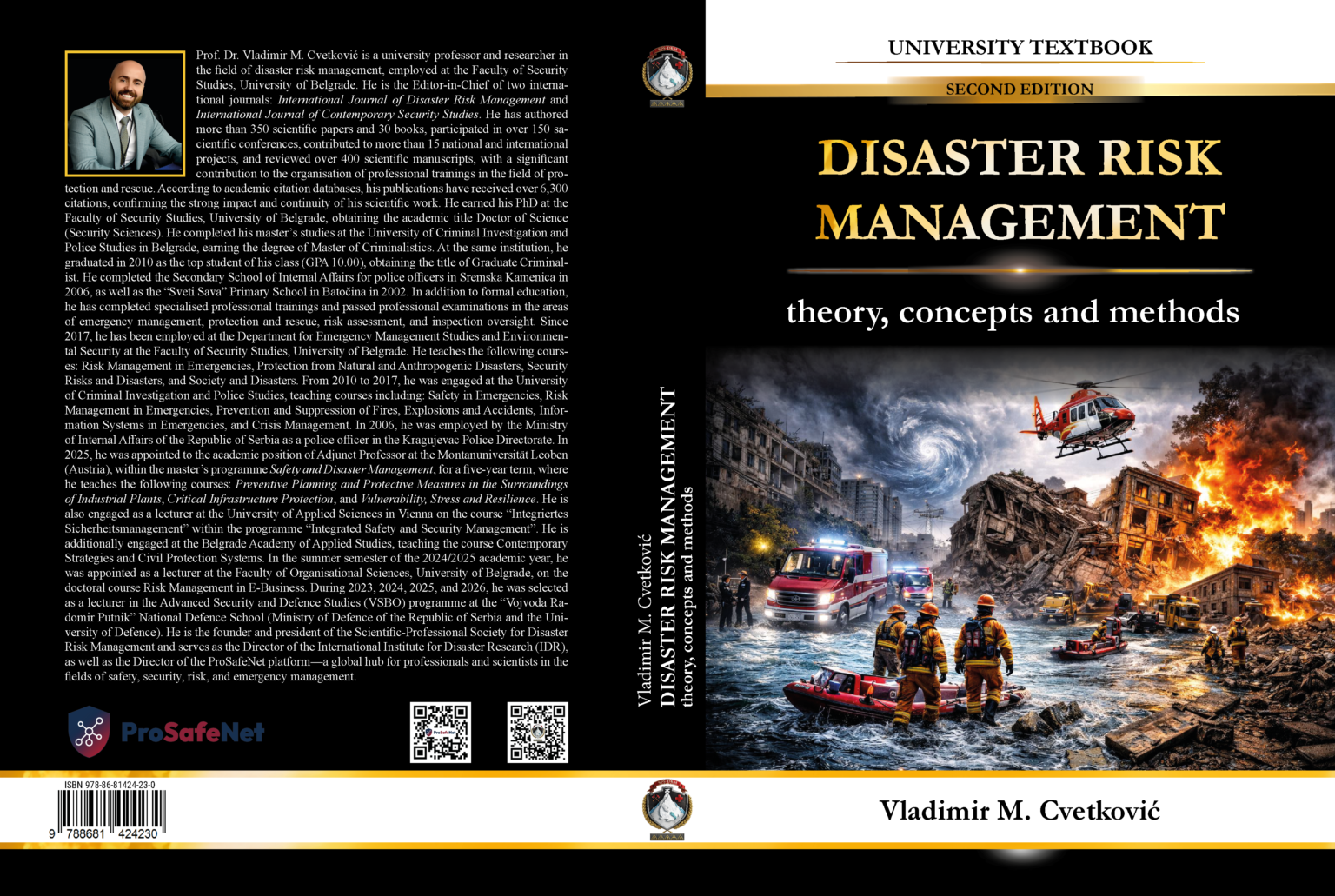
English Edition
International academic edition for teaching, research, professional training, and institutional use.
University-level textbooks and professional reference works by Prof. Dr. Vladimir M. Cvetković, connecting disaster theory, risk assessment, preparedness, resilience, operational response, protection and rescue, research methodology, and regulatory frameworks.
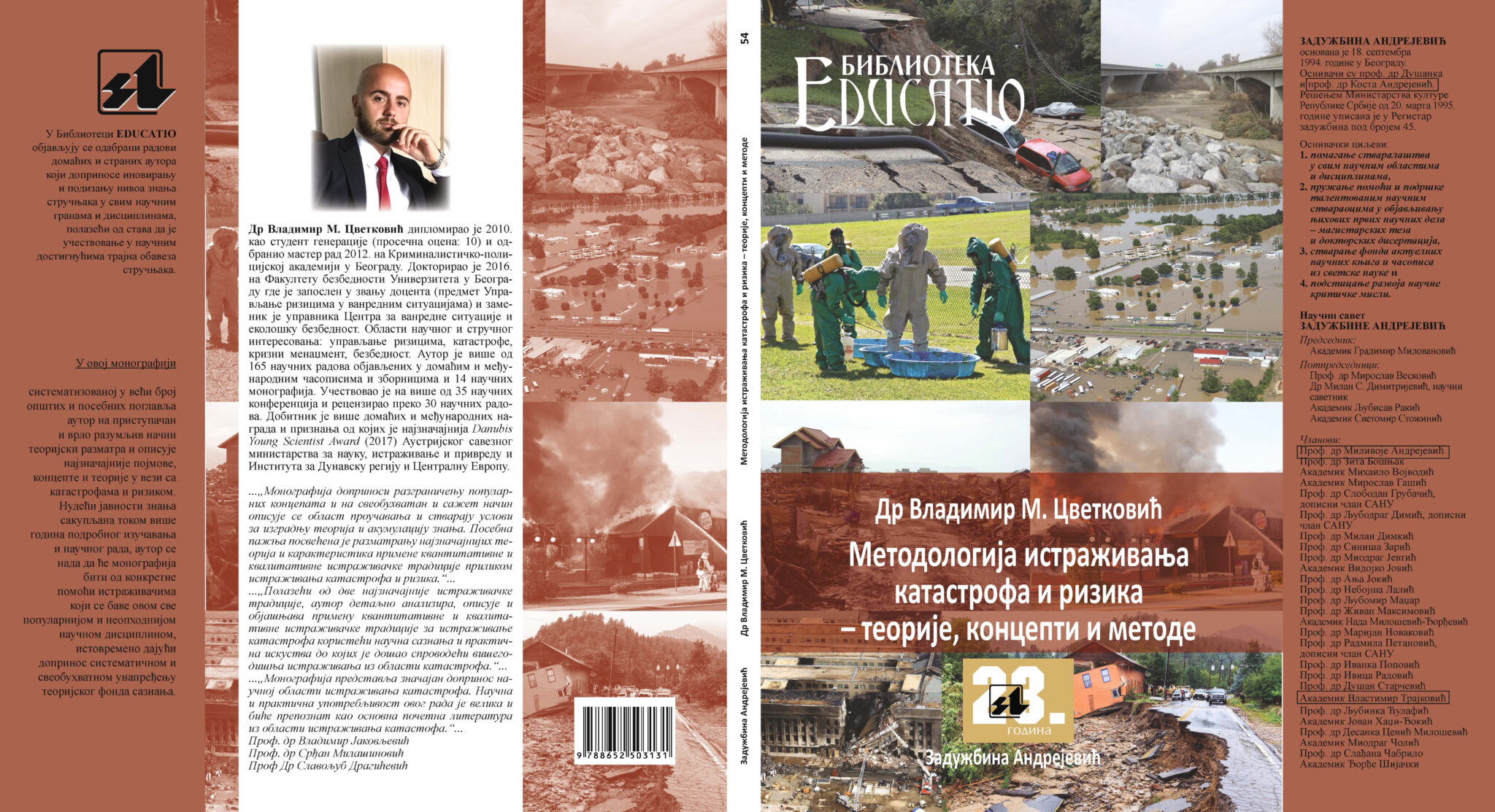
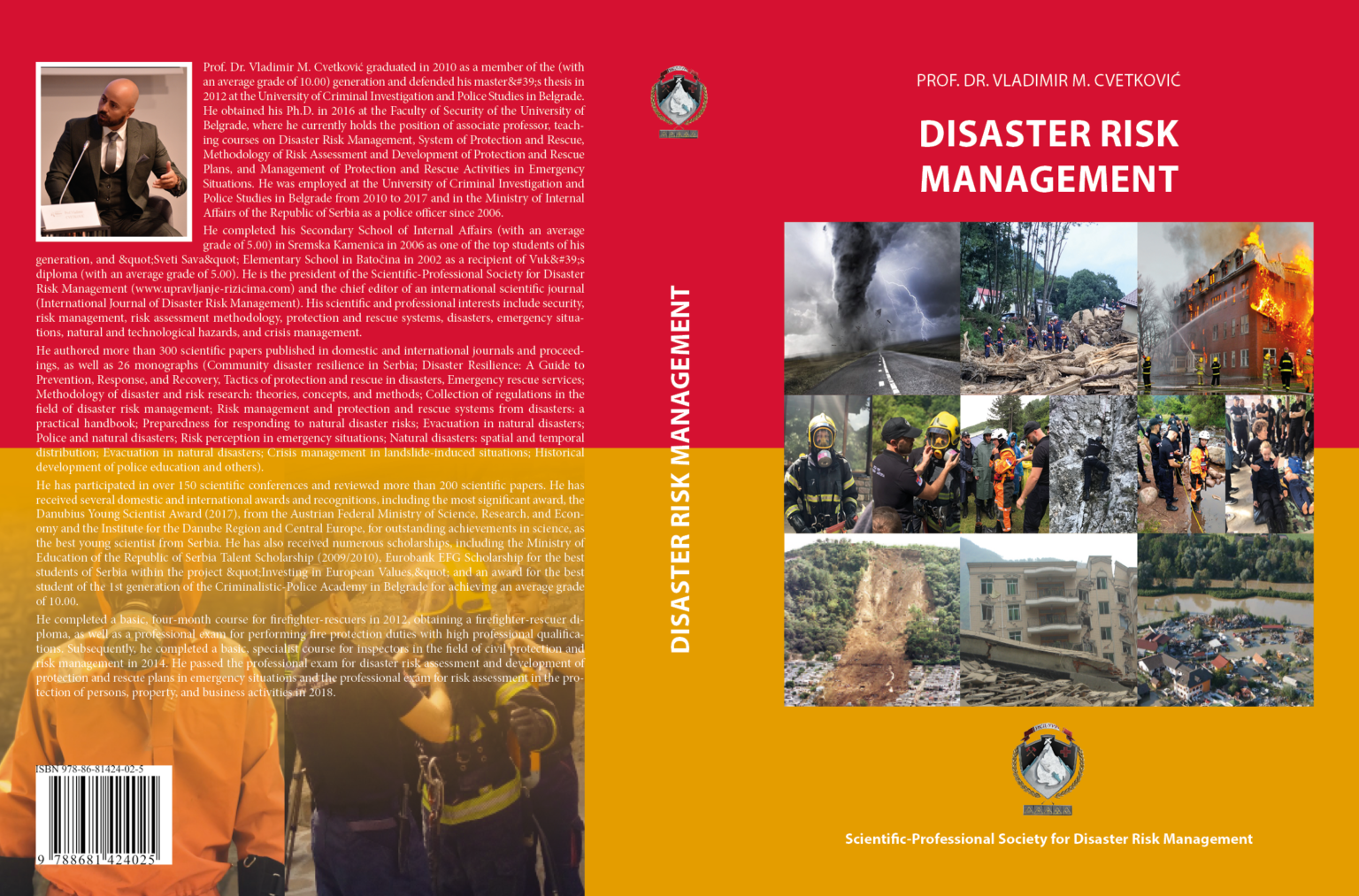
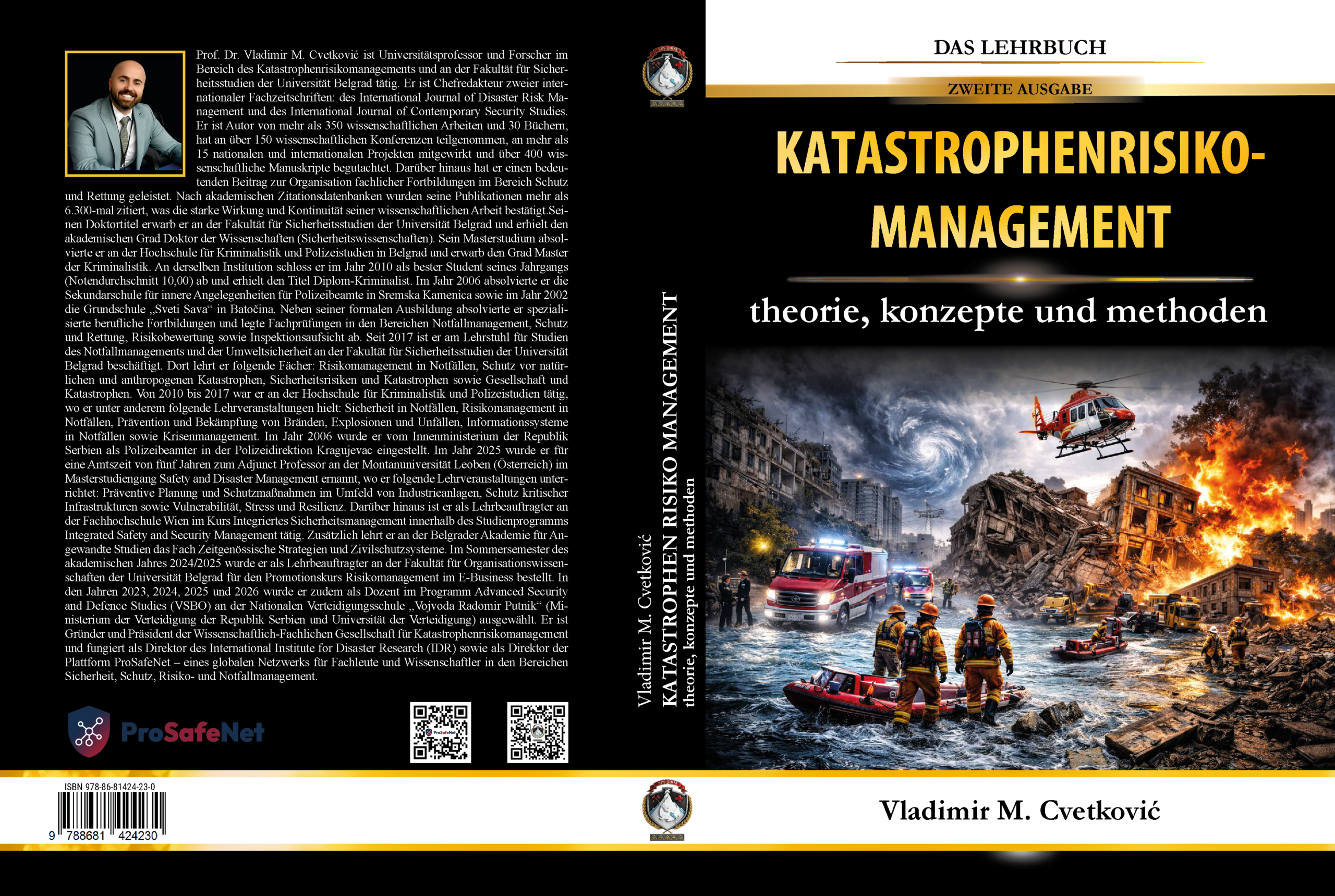
 Selected academic textbooks · English · German · Serbian
Continue to dedicated publication sections for research monographs, teaching practicums, and edited scholarly volumes.
Research-focused scholarly books developing theoretical, empirical, and methodological contributions across disaster and security studies.
Explore Monographs →Practice-oriented teaching resources, exercises, cases, and structured materials for university and professional learning.
Explore Practicums →Edited proceedings, thematic collections, conference publications, and collaborative scholarly volumes.
Explore Edited Volumes →
A comprehensive academic and professional reference connecting disaster theory, multi-hazard risk assessment, vulnerability, resilience, preparedness, response, recovery, risk communication, critical infrastructure, governance, decision-making methods, and digital approaches.
The flagship textbook is presented for wider academic and professional use across different language communities.
International academic edition for teaching, research, professional training, and institutional use.
German-language academic edition prepared for German-speaking university and professional audiences.
Serbian-language reference supporting university teaching and professional disaster-management practice.
Explore core domains across disaster risk reduction, emergency management, resilience, security, research, law, and operational practice. Click any topic to filter the textbook library.
The collection connects prevention and preparedness with operational response, recovery, and long-term resilience.
Open each method for a concise description of its role in risk analysis, safety assessment, decision support, and disaster research.
Structured scenario questioning used to identify hazards, deviations, consequences, and safeguards.
Early-stage screening of hazards, causes, consequences, likelihood, severity, and risk-control priorities.
Systematic examination of process deviations using guide words to identify hazards and operability problems.
Failure-mode analysis for identifying component failures, effects, criticality, and mitigation priorities.
Layer of Protection Analysis evaluates whether independent protection layers adequately reduce scenario risk.
Visual integration of threats, preventive barriers, top events, consequences, and mitigative barriers.
Deductive modelling of combinations of failures that can produce a defined undesired top event.
Forward branching analysis of possible outcomes following an initiating event and barrier success or failure.
Systematic investigation of underlying causal mechanisms behind accidents, failures, and adverse events.
Quantitative integration of event probabilities, system behaviour, and consequences to estimate risk.
Repeated random sampling to propagate uncertainty and estimate distributions of outcomes and risk metrics.
Probabilistic graphical modelling for updating beliefs, causal inference, and decision support under uncertainty.
State-transition modelling of systems whose future condition depends on the current state and transition probabilities.
Statistical methods for analysing rare extremes such as severe floods, heat, wind, or other high-impact events.
Simulation of systems as sequences of events, useful for queues, emergency operations, logistics, and resource allocation.
Feedback-based modelling of complex systems, accumulations, delays, and policy effects over time.
Multi-criteria approaches that structure preferences and combine diverse indicators for risk-informed decisions.
Economic comparison of risk-reduction investments and expected avoided losses or wider benefits.
Structured learning from foundational concepts to advanced methods.
Theories, concepts, methods, models, indicators, and research pathways.
Teaching resources and references for disaster, security, and resilience courses.
Preparedness, coordination, response, logistics, communication, and recovery.
Protection and rescue, operational roles, planning, and institutional capacity.
Governance, regulation, resilience investment, and risk-informed public policy.
Select a learning or professional goal and receive an instant recommendation.
Best all-round choice for an integrated understanding of disaster risk, preparedness, resilience, assessment methods, response, recovery, and governance.
| Title | Risk | Response | Research | Law | Resilience | Methods |
|---|---|---|---|---|---|---|
| Disaster Risk Management: Theory, Concepts and Methods (2026) | High | ✓ | ✓ | ✓ | High | High |
| Essential Tactics for Disaster Protection and Rescue (2022) | ✓ | High | — | ✓ | ✓ | — |
| Disaster Risk Management (2020) | High | ✓ | ✓ | — | High | ✓ |
| Methodology of Disaster and Risk Research (2017) | ✓ | — | High | — | ✓ | High |
| Collection of Regulations — Emergency Situations (2022) | ✓ | ✓ | — | High | — | — |
| Collection of Regulations — Disaster Risk Management (2019) | ✓ | — | — | High | — | — |
A chapter-style explorer highlighting the major areas integrated within the flagship textbook.
Definitions, evolution of disaster studies, disciplinary perspectives, disaster risk concepts, and integrated approaches.
Natural, technological and anthropogenic hazards, interactions, compound events, and cascading consequences.
Qualitative, quantitative, probabilistic, simulation, multi-criteria, barrier, and spatial analytical methods.
Individual, social, economic, institutional, infrastructural, environmental, and spatial dimensions of vulnerability.
Community and systemic resilience, capacities, indicators, adaptation, learning, and resilience-building strategies.
Planning, training, resources, exercises, household readiness, institutional preparedness, and public education.
Activation, coordination, situational awareness, warning, evacuation, search and rescue, public health, and emergency communication.
Damage assessment, restoration, reconstruction, social recovery, learning, and building back better.
Dependencies, continuity, cascading failure, protection measures, and resilience of essential systems.
Warning, public information, perception, trust, media, uncertainty, and communication before, during, and after disasters.
Institutions, policy, legal frameworks, coordination, international mechanisms, and multi-level risk governance.
GIS, remote sensing, databases, digital platforms, decision-support systems, mapping, and emerging technologies.
Concepts, models, disaster science, vulnerability, resilience, risk perception, governance and systems thinking.
Risk assessment, modelling, simulation, probability, decision methods, GIS, indicators, registers and analytical tools.
Preparedness, emergency planning, protection and rescue, response coordination, communication, recovery and professional application.
Core or supporting literature for undergraduate, master’s, doctoral and professional courses.
Theoretical frameworks, concepts, methodological choices, models, indicators and analytical techniques.
Preparedness, continuity, coordination, resources, warning, evacuation and operational decision-making.
Governance, regulation, resilience investment, risk-informed decisions and institutional capacity.
Connects the entire disaster-management cycle rather than treating topics in isolation.
Structured around research-informed concepts, theories, methods and professional practice.
Bridges security, geography, engineering, public health, governance, law and social science.
Links analytical knowledge to planning, operations, decision-making, and institutional implementation.
The collection supports courses and teaching units covering risk, planning, resilience, critical infrastructure, civil protection, and environmental security.
Integration of established and emerging research across disaster studies.
Research-informed interpretation of preparedness, vulnerability, resilience and risk perception.
Comparative perspectives and cross-system learning for disaster governance and response.
Operational and institutional perspectives relevant to emergency-management implementation.
Use the publication cards below for title-specific access or start with the flagship book.
Select a title and citation style. Always verify final formatting against the requirements of your journal, university, or publisher.
Year, title, authorship, edition, publisher and language are displayed directly on each record.
English abstracts and topic tags support discovery, teaching selection and research relevance.
Where available, records point to a public PDF or publication record rather than an unverified copy.
Copy recommended citations and download EndNote-tagged records from individual book cards.
Institutional and library acquisition inquiries can cover individual titles, multiple copies, language editions, and availability.
Explore the collection for teaching adoption, reading lists, professional courses and specialist training.
Click a cover to jump directly to its full academic record in the library.
Disaster Risk Management: Theory, Concepts and Methods — revised and expanded flagship edition.
The 2026 flagship integrates theory, risk assessment methods, resilience, response, recovery, governance and digital tools.
Essential Tactics for Disaster Protection and Rescue focuses on operational systems, services, command and hazard-specific response.
Where a public full-text or publication record is available, the relevant book card includes a direct PDF / Full Text button. Availability differs by title.
Use the Order Print Copy button on an individual title or contact the SPS-DRM Secretariat at secretary@spsdrm.org with the title, quantity, delivery country, and institution if applicable.
Yes. Universities, libraries, departments, research institutes and training centres can send an institutional acquisition inquiry for availability, quantities, payment and shipping.
The 2026 flagship book is presented in English, German and Serbian editions. Individual availability should be confirmed with the publisher.
Yes. The collection is structured for academic and professional use. Course coordinators can contact the publisher regarding teaching adoption and multiple-copy requests.
Each book record includes a recommended APA 6th citation. The Citation Center also generates convenient APA 7, Chicago, Harvard, BibTeX and EndNote-style outputs; final style requirements should always be verified.
Yes. Each book card provides an EndNote download, and the Citation Center can also generate the selected book as an EndNote tagged record.
Use the three publication pathway cards near the top of this page to open the dedicated Monographs, Practicums and Edited Volumes sections.
For potential translation rights, international academic distribution, institutional publishing cooperation, teaching adoption, bulk orders or new-edition information, contact the SPS-DRM Secretariat.
Enquiries regarding potential language editions and international translation cooperation.
Institutional, university, professional and international distribution discussions.
Course use, reading lists, classroom quantities, academic cooperation and review-copy enquiries.
Request information about revised editions, new books and academic publishing activities.
Each record includes an English abstract, APA 6th recommended citation, available full-text/PDF access, and a direct print-order inquiry to the SPS-DRM Secretariat.
For printed copies, institutional procurement, university-library orders, multiple-copy requests, teaching adoption, or information about available language editions, contact the SPS-DRM Secretariat.