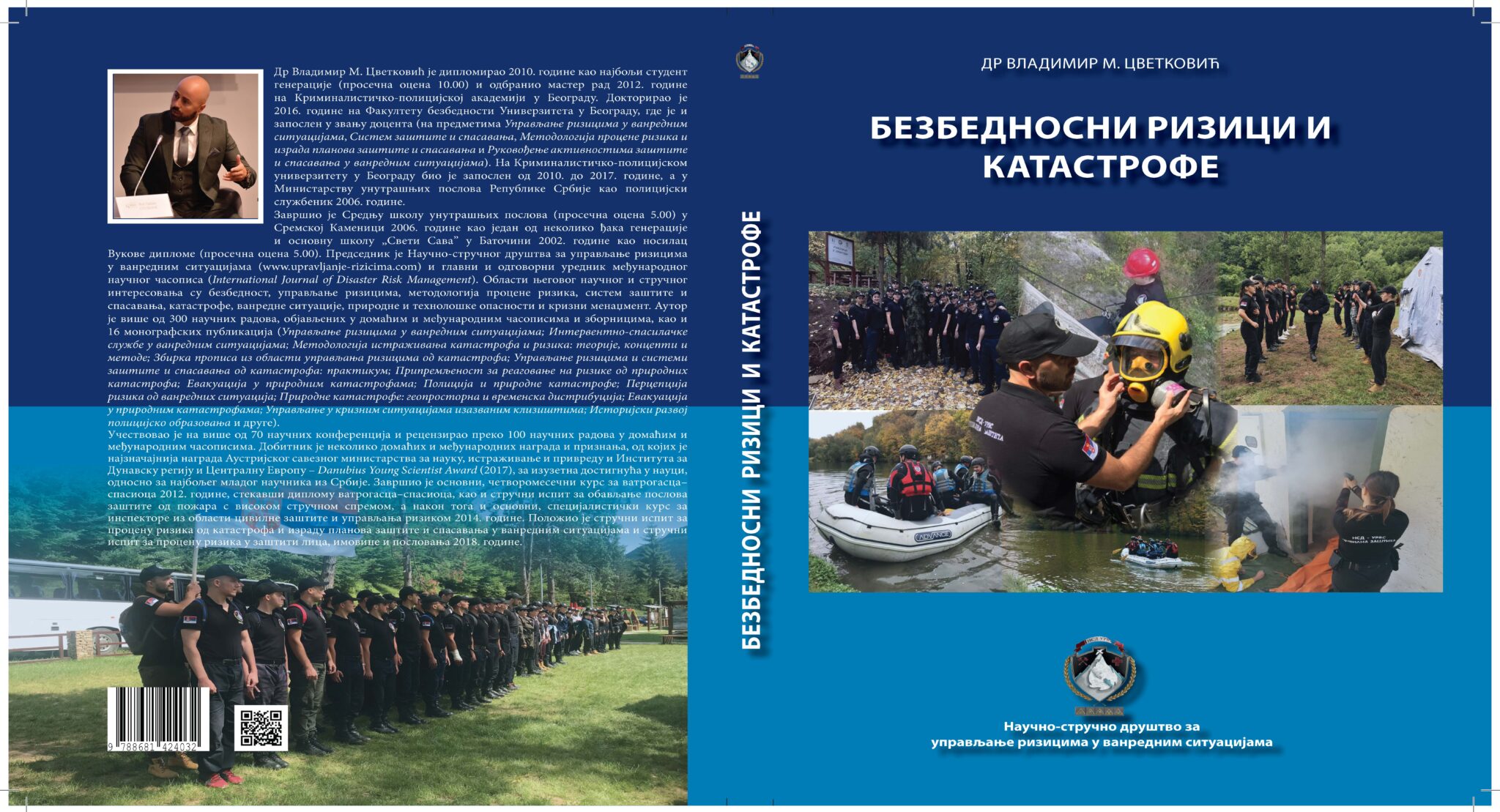
The manual “Security Risks and Disasters” is intended for undergraduate and master’s students at the Faculty of Security Studies at the University of Belgrade, the University of Criminalistics and Police Studies, and other faculties, to introduce them to the academic discipline in the field of disaster studies. The manual is based on years of experience that the author has in scientific research and teaching in this field. It is designed to facilitate the theoretical and practical exercises of students, aiming to ease the learning process in the field of security risks and disasters. Given the multidisciplinary nature of the subject matter, the manual consists of numerous theoretical exercises that guide students toward the most important segments of the material, motivating them to engage actively in the exercises during the lessons. The manual covers the following topics: I – Methodological Foundations of Disaster Research; II – Phenomenology of Disasters and Hazards; III – Vulnerability to Disasters; IV – Disaster Resilience; V – Integrated Disaster Risk Management; VI – Disaster Risk Prevention and Mitigation; VII – Preparedness for Natural and Anthropogenic Disasters; VIII – Protection from Natural and Anthropogenic Disasters; IX – Recovery from Natural and Anthropogenic Disasters; X – Information Systems and Disaster Risk Management; XI – International Cooperation in Disaster Risk Reduction. Each section includes several exercises that begin with an introduction, followed by exercises and discussion questions. The manual draws on a large number of books authored by the writer, such as Disaster Risk Management, Collection of Regulations on Disaster Risk Management, Methodology of Disaster and Risk Research: Theories, Concepts, and Methods, Natural Disasters and Education, Police and Natural Disasters, Evacuation in Natural Disasters, Risk Perception in Emergencies, among others. The latest scientific literature in the field of disaster studies has also been included in the preparation of the manual. Building on the theoretical elaborations of the methodological foundations of disaster research, the second section of the manual addresses the “Phenomenology of Disasters and Hazards”. In this section, students are introduced to theoretical content in the following areas: the concept, nature, and characteristics of hazards; the concept and characteristics of disasters; classification of hazards and disasters; lithospheric disasters; atmospheric disasters; biospheric disasters; disasters caused by technical and technological hazards; disasters caused by the use of weapons of mass destruction; disaster consequences; trends and spatio-temporal distribution of disasters; myths, ethics, models, and disasters. By completing exercises on the mentioned topics, students acquire basic knowledge that ensures: understanding of the conceptual definitions of hazards and disasters, classification of hazards and disasters, the conceptual definitions of earthquakes, landslides, volcanic eruptions, floods, torrents, tsunamis, storm-hail phenomena, droughts, extreme low and high temperatures, wildfires, epidemics, epizootics, and epiphytotics, various types of technical and technological hazards, various types of weapons of mass destruction, understanding different perspectives on disaster consequences, trends, and spatio-temporal distributions of disasters, disaster myths, ethical issues, and models; familiarity with the basic characteristics of hazards, various types of disasters, familiarity with different criteria for disaster classification, familiarity with the basic characteristics of earthquakes, landslides, volcanic eruptions, floods, torrents, tsunamis, storm-hail phenomena, droughts, extreme low and high temperatures, wildfires, epidemics, epizootics, and epiphytotics, different types of technical and technological hazards, different types of weapons of mass destruction, familiarity with health, physical, ecological, economic, and psychological consequences of disasters, familiarity with disasters through a historical perspective and the consequences that disaster myths can cause; describing the nature of hazards, characteristics of various natural and anthropogenic disasters, contrasting perspectives on disaster classification, different types of earthquakes, landslides, volcanic eruptions, floods, torrents, tsunamis, storm-hail phenomena, droughts, extreme low and high temperatures, wildfires, epidemics, epizootics, and epiphytotics, nuclear and radiological disasters, industrial and transportation disasters, disasters caused by hazardous materials, war destruction and fires, describing nuclear, biological, chemical, and radiological weapons, as well as high-explosive ordnance, describing the characteristics of various disaster consequences, describing disasters in the global and national geospace, and ethical principles in disaster risk management; recognizing the most significant natural and anthropogenic hazards, different dimensions of disasters, basic principles of disaster classification, causes of the mentioned disasters, recognizing the direct and indirect causes of hydrospheric, atmospheric, and biospheric disasters, different causes of disasters caused by technical and technological hazards and the misuse of weapons of mass destruction, different dimensions and possibilities for preventing and mitigating the consequences of disasters, the possibility of using different disaster databases and different models to interpret the complex nature of reality. In light of the proactive actions of people to mitigate future disaster consequences, the fourth section deals with “Disaster Resilience” and includes exercises related to: the concept and characteristics of disaster resilience; dimensions of disaster resilience; analysis and measurement of resilience: global indicators; local indicators of disaster resilience; enhancement and components of disaster resilience. Through the exercises on these topics, students gain fundamental knowledge that ensures understanding of the basic characteristics of the definition of disaster resilience, various dimensions of disaster resilience, methods of analyzing and measuring resilience, local indicators of disaster resilience, and multiple ways to enhance disaster resilience; familiarity with: various definitions of disaster resilience, resilience as a biophysical and social attribute of a specific area, the evolution of the development of indicators for measuring disaster resilience, the basic characteristics of various indicators for measuring disaster resilience, as well as a wide range of activities to improve the capacity of local communities to mitigate disaster risks; describing the multidisciplinary framework of disaster resilience, the three-dimensional model of disaster resilience, specific indicators for measuring resilience for specific disasters, and communication strategies for integrated disaster risk mitigation; recognizing the multidisciplinary framework for understanding disaster resilience, the basic characteristics of the four-dimensional framework of resilience encompassing robustness, redundancy, resourcefulness, and rapidity, acquiring knowledge about the basic characteristics of resilience in citizens, households, and local communities, engineering, institutional, and ecological resilience, recognizing the features of various resilience indicators, the basic advantages and disadvantages of local indicators for measuring disaster resilience, and the basic characteristics of a conceptual review of communication strategies for improving disaster resilience. In the fifth section of the manual, which covers “Integrated Disaster Risk Management”, exercises are provided on: the concept, types, and characteristics of disaster risks; the disaster risk management process; the conceptual framework and indicators of disaster risk management; disaster risk assessment models; risk maps and problems of risk analysis; the methodology of risk assessment; public information on disaster risks. Through the exercises on these topics, students acquire basic knowledge that ensures: understanding of the conceptual definition of disaster risks and the disaster risk management process, the conceptual framework of disaster risk management, disaster risk assessment models, the risk assessment methodology, and methods of public information on disaster risks; familiarity with: different types of disaster risks, key steps in the disaster risk management process, basic indicators of disaster risk management, key parameters for assessing risk assessment models, various disaster risk maps, and procedures for informing the public about disaster risks; describing the characteristics of disaster risks, the conceptual review of integrated disaster risk management, specific disaster risk management indicators, specific dynamic models, various risk assessment problems, methods of collecting and disseminating information on risks; recognizing different concepts of disaster management, the basic characteristics of different phases of disaster management, the advantages and disadvantages of disaster risk management indicators, various conceptual frameworks for disaster risk reduction, disaster risk assessment methods, and the functioning of disaster risk information in practice. Recognizing the significance of proactive measures to prevent or mitigate the consequences of disasters, the sixth chapter focuses on “Disaster Risk Prevention and Mitigation” and covers the following teaching units: The concept of disaster risk mitigation; Strategies and measures for disaster risk mitigation; Functions of disaster risk mitigation; Mitigation of risks caused by natural hazards; Mitigation of risks caused by technical and technological hazards; Social networks and disaster risk reduction. Through the exercises on these topics, students acquire fundamental knowledge that ensures: understanding of the key goals of disaster risk mitigation, short-term and long-term measures for disaster risk mitigation, the functions of disaster risk mitigation, possibilities for mitigating the risks of lithospheric disasters, methods of mitigating the risks of technical and technological disasters, ways of using social networks in disaster management processes; familiarity with: the basic characteristics of risk mitigation, basic strategies for risk mitigation, methods of reducing the likelihood of disasters, characteristics of specific risk mitigation measures for disasters, specific measures for mitigating the risks of technical and technological disasters, the basic characteristics of using social networks in disaster management processes; describing specific stages of disaster emergence and development, general structural and non-structural measures for disaster risk mitigation, methods of reducing disaster consequences, methods of mitigating hydrospheric disaster risks, various risk mitigation measures, possibilities for using social networks to mitigate disaster risks; recognizing specific structural and non-structural measures for disaster risk mitigation, possibilities for applying specific measures for disaster risk mitigation, various possibilities for avoiding or transferring risks, possibilities for mitigating disaster risks, possibilities for using measures for disaster risk mitigation, the basic characteristics of various social networks. The manual provides an extensive and systematic approach to equipping students with the necessary knowledge and practical skills required for understanding and managing security risks and disasters effectively.
Prof. Dr. Vladimir M. Cvetković is a recognized expert in Disaster Risk Management, with extensive experience in disaster risk reduction, community preparedness, disaster response, and recovery. His work focuses on improving the safety and resilience of communities. Professor Dr. Vladimir M. Cvetković has dedicated his career to advancing knowledge and understanding in the fields of disaster studies, emergency situations, and security. With a prolific output, he has authored more than 30 books, each contributing valuable insights and expertise to these critical areas of study. Through his extensive research and publications, Dr. Cvetković has become a leading authority, shaping discourse and informing policies related to disaster and crisis management both in Serbia and beyond. His works cover a wide range of topics, including but not limited to risk assessment, disaster preparedness, response strategies, and post-crisis recovery. By examining case studies, analyzing historical events, and presenting theoretical frameworks, Dr. Cvetković provides comprehensive perspectives on the complex dynamics of crises and their management. Moreover, his interdisciplinary approach incorporates insights from fields such as sociology, psychology, public health, and engineering, enriching the discourse with multifaceted viewpoints. In addition to his scholarly contributions, Dr. Cvetković is actively engaged in practical initiatives aimed at enhancing resilience and mitigating risks in various contexts. As a member of the Scientific-Expert Society for Risk Management in Emergency Situations, based in Belgrade, he collaborates with professionals, policymakers, and stakeholders to develop effective strategies and solutions. His expertise is sought after in consultancy projects, training programs, and advisory roles, where he applies his theoretical knowledge to real-world challenges, fostering greater preparedness and response capabilities. Furthermore, Dr. Cvetković’s impact extends beyond academia and professional circles, as he strives to raise public awareness and promote community engagement in disaster resilience. Through outreach activities, media appearances, and educational campaigns, he advocates for proactive measures and collective responsibility in building safer and more resilient societies. By bridging the gap between research, policy, and public awareness, Dr. Cvetković plays a crucial role in fostering a culture of resilience and preparedness, ultimately contributing to the well-being and security of communities in Serbia and worldwide.
Recommended book citations:
- Cvetković, V. (2026). Disaster risk management: Theory, concepts and methods [Upravljanje rizicima od katastrofa: teorija, koncepti i metode]. Belgrade, Serbia: Scientific-Professional Society for Disaster Risk Management.
- Gajović, A., & Cvetković, V. (2026). Digital environmental education: A model connecting stakeholder engagement with sustainable development goals and the European Green Deal [Digitalno obrazovanje o životnoj sredini: model povezivanja angažovanja stejkholdera sa ciljevima održivog razvoja i Evropskim zelenim dogovorom]. Belgrade, Serbia: Scientific-Professional Society for Disaster Risk Management.
- Cvetković, V., & Šišović, V. (2024). Community disaster resilience in Serbia [Otpornost zajednica na katastrofe u Srbiji]. Belgrade, Serbia: Scientific-Professional Society for Disaster Risk Management.
- Tanasić, J., & Cvetković, V. (2024). The efficiency of disaster and crisis management policy at the local level: Lessons from Serbia [Efikasnost politike upravljanja katastrofama i krizama na lokalnom nivou: pouke iz Srbije]. Belgrade, Serbia: Scientific-Professional Society for Disaster Risk Management.
- Tanasić, J., & Cvetković, V. (2024). Policy of crisis management in Serbia [Politika kriznog upravljanja u Srbiji]. Belgrade, Serbia: Scientific-Professional Society for Disaster Risk Management.
- Grozdanić, G., & Cvetković, V. (2024). Exploring multifaceted factors influencing community resilience to earthquake-induced geohazards: Insights from Montenegro [Istraživanje višedimenzionalnih faktora koji utiču na otpornost zajednica na geohazarde izazvane zemljotresima: uvidi iz Crne Gore]. Belgrade, Serbia: Scientific-Professional Society for Disaster Risk Management.
- Cvetković, V., & Renner, R. (2024). Comprehensive databases on natural and man-made (technological) hazards and disasters: Mapping risks and challenges [Sveobuhvatne baze podataka o prirodnim i antropogenim (tehnološkim) opasnostima i katastrofama: mapiranje rizika i izazova]. Belgrade, Serbia: Scientific-Professional Society for Disaster Risk Management.
- Cvetković, V. (2023). Disaster resilience: A guide to prevention, response, and recovery [Otpornost na katastrofe: vodič za prevenciju, reagovanje i oporavak]. Belgrade, Serbia: Naučno-stručno društvo za upravljanje rizicima u vanrednim situacijama.
- Cvetković, V. (2023). Historical development of the Scientific-Professional Society for Disaster Risk Management [Istorijski razvoj Naučno-stručnog društva za upravljanje rizicima u vanrednim situacijama]. Belgrade, Serbia: Naučno-stručno društvo za upravljanje rizicima u vanrednim situacijama.
- Cvetković, V. (2023). Integrated disaster risk management: Preparedness, mitigation, response, and recovery [Integrisano upravljanje rizicima od katastrofa: pripremljenost, ublažavanje, odgovor i oporavak]. Belgrade, Serbia: Naučno-stručno društvo za upravljanje rizicima u vanrednim situacijama.
- Cvetković, V. (2023). Preparedness of secondary schools in the West Morava Basin in the Republic of Serbia for disaster risk reduction and emergency management [Spremnost srednjih škola sliva Zapadne Morave u Republici Srbiji za smanjenje rizika od katastrofa i upravljanje u vanrednim situacijama]. Belgrade, Serbia: Fenomena.
- Nikolić, N., Cvetković, V., & Ivanov, A. (2023). Human resource management in environmental security [Upravljanje ljudskim resursima u oblasti ekološke bezbednosti]. Belgrade, Serbia: Scientific-Professional Society for Disaster Risk Management.
- Cvetković, V., & Čaušić, L. (2022). Collection of regulations in the field of emergency situations [Zbirka propisa iz oblasti vanrednih situacija]. Belgrade, Serbia: Naučno-stručno društvo za upravljanje rizicima u vanrednim situacijama.
- Cvetković, V. (2022). Tactics of protection and rescue in disasters [Taktika zaštite i spasavanja u katastrofama]. Belgrade, Serbia: Naučno-stručno društvo za upravljanje rizicima u vanrednim situacijama.
- Cvetković, V. (2021). Legal and security aspects of disaster risk management from natural and anthropogenic disasters [Pravni i bezbednosni aspekti upravljanja rizicima od prirodnih i antropogenih katastrofa]. Belgrade, Serbia: Faculty of Law in Novi Sad; Naučno-stručno društvo za upravljanje rizicima u vanrednim situacijama.
- Cvetković, V., & Jovanović, M. (2021). Disaster myths: Truths and misconceptions [Mitovi o katastrofama: istine i zablude]. Belgrade, Serbia: Naučno-stručno društvo za upravljanje rizicima u vanrednim situacijama.
- Cvetković, V., & Martinović, J. (2021). Nuclear Disaster Management [Upravljanje u nuklearnim katastrofama]. Belgrade, Serbia: Naučno-stručno društvo za upravljanje rizicima u vanrednim situacijama.
- Cvetković, V. (2021). Security risks and disasters [Bezbednosni rizici i katastrofe]. Belgrade, Serbia: Naučno-stručno društvo za upravljanje rizicima u vanrednim situacijama.
- Cvetković, V. (2020). Disaster Risk Management [Upravljanje rizicima u vanrednim situacijama]. Belgrade, Serbia: Naučno-stručno društvo za upravljanje rizicima u vanrednim situacijama.
- Cvetković, V., Filipović, M., & Gačić, J. (2019). Collection of regulations in the field of disaster risk management [Zbirka propisa iz oblasti upravljanja rizicima od katastrofa]. Belgrade, Serbia: Naučno-stručno društvo za upravljanje rizicima u vanrednim situacijama.
- Cvetković, V. (2019). Risk management and disaster protection and rescue systems [Upravljanje rizicima i sistemi zaštite i spasavanja od katastrofa]. Belgrade, Serbia: Naučno-stručno društvo za upravljanje rizicima u vanrednim situacijama.
- Cvetković, V., Bošković, D., Janković, B., & Andrić, S. (2019). Risk perception of emergency situations [Percepcija rizika od vanrednih situacija]. Belgrade, Serbia: Criminalistic-Police Academy.
- Cvetković, V., Milašinović, S., & Gostimirović, L. (2018). Historical development of police education in Serbia [Istorijski razvoj policijskog obrazovanja u Srbiji]. Doboj, Bosnia and Herzegovina: College of Business and Technical Studies.
- Cvetković, V. (2017). Methodology of disaster research: Theories, concepts and methods [Metodologija istraživanja katastrofa – teorije, koncepti i metode]. Belgrade, Serbia: Zadužbina Andrejević.
- Cvetković, V., & Filipović, M. (2017). Preparedness for natural disasters: Recommendations for improvement [Pripremljenost za prirodne katastrofe – preporuke za unapređenje pripremljenosti]. Belgrade, Serbia: Zadužbina Andrejević.
- Miladinović, S., Cvetković, V., & Milašinović, S. (2017). Management in landslide-induced crisis situations [Upravljanje u kriznim situacijama izazvanim klizištima]. Belgrade, Serbia: Criminalistic-Police Academy.
- Bošković, D., & Cvetković, V. (2017). Risk assessment in preventing criminal acts involving explosive materials [Procena rizika u sprečavanju izvršenja krivičnih dela eksplozivnim materijama]. Belgrade, Serbia: Criminalistic-Police Academy.
- Cvetković, V. (2016). Police and natural disasters [Policija i prirodne katastrofe]. Belgrade, Serbia: Zadužbina Andrejević.
- Cvetković, V., & Gačić, J. (2016). Evacuation in natural disasters [Evakuacija u prirodnim katastrofama]. Belgrade, Serbia: Zadužbina Andrejević.
- Ivanov, A., & Cvetković, V. (2016). Natural disasters: Geospatial and temporal distribution [Prirodni katastrofi – geoprostorna i vremenska distribucija]. Skopje, North Macedonia: Faculty of Security, University “St. Kliment Ohridski”–Bitola.
- Jakovljević, V., Cvetković, V., & Gačić, J. (2015). Natural disasters and education [Prirodne katastrofe i obrazovanje]. Belgrade, Serbia: Faculty of Security, University of Belgrade.
- Cvetković, V. (2013). First responders in emergency situations [Interventno-spasilačke službe u vanrednim situacijama]. Belgrade, Serbia: Zadužbina Andrejević.
Security Risks and Disasters
Risk Management and Disaster Protection and Rescue Systems
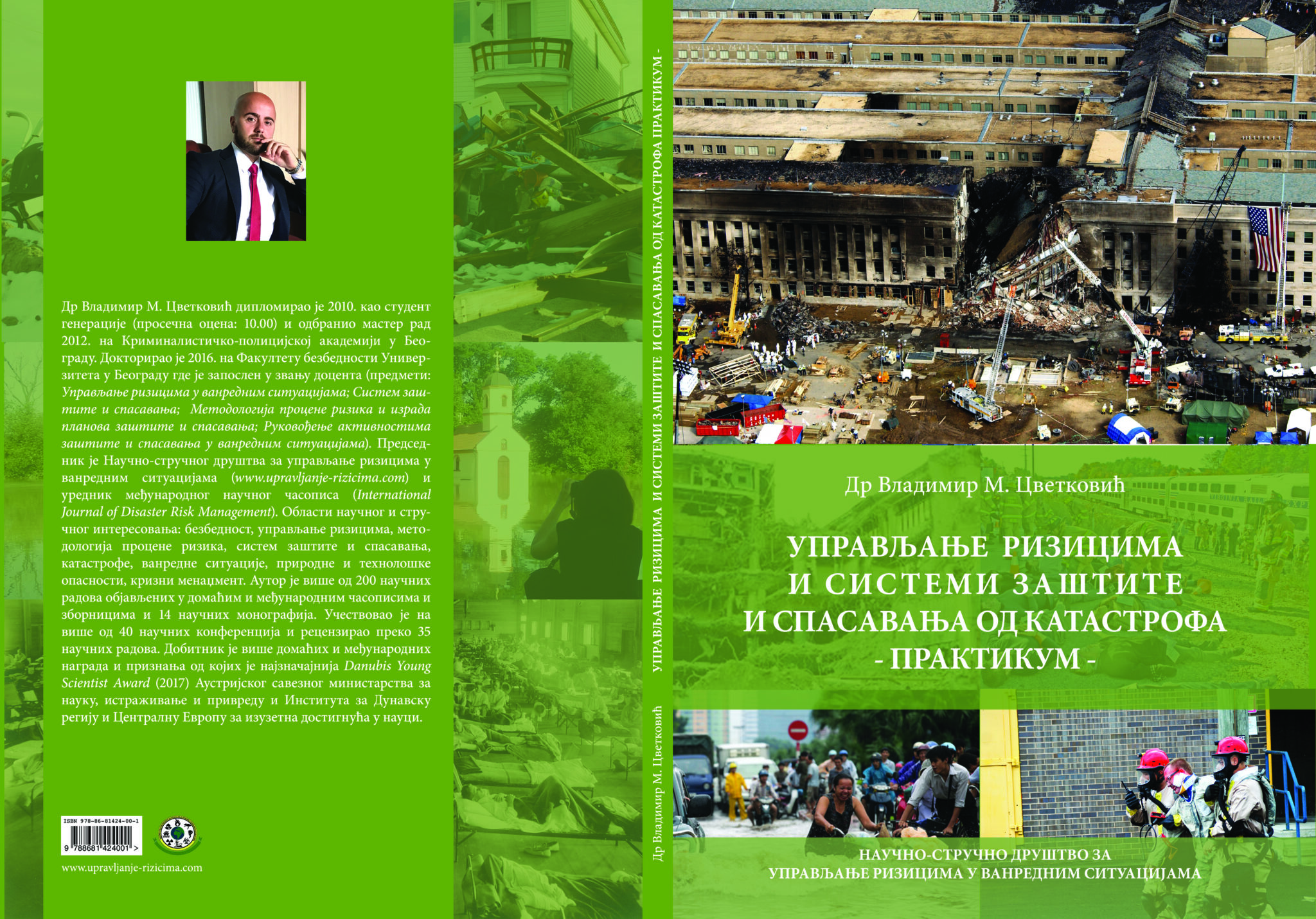
Practicum “Risk Management and Disaster Protection and Rescue Systems” is intended for undergraduate and master’s students at the Faculty of Security Studies, University of Belgrade, the University of Criminal Investigation and Police Studies, and other faculties, to introduce them to the academic discipline of disaster studies. The practicum is based on years of experience that the author has gained working with students from the mentioned faculties. It is designed for the implementation of theoretical and practical exercises for students, aiming to facilitate the learning process of topics related to risk management and disaster protection and rescue systems. Starting from the multidisciplinary nature of the subject matter, the practicum consists of numerous theoretical exercises that direct students to the most important segments of the material, motivating them to engage in class activities during the planned exercises. The practicum covers the following teaching topics: I – Disasters and Hazards: Theories, Concepts, and Methods; II – Vulnerability, Resilience, and Disaster Research Methods; III – Disaster Risk: Assessment Methodology and Protection and Rescue Plans; IV – National and International Legal Framework for Disaster Risk Reduction; V – Preparedness and Mitigation of Disaster Risks; VI – Disaster Protection and Rescue Systems: Response and Recovery; VII – Information Systems for Disaster Risk Management Support and International Cooperation. Each section consists of several exercises, where students are first given an introductory discussion, followed by tasks for the exercises, discussion questions, and recommended literature. The practicum incorporates the latest literature in disaster studies. The author expresses special gratitude to the reviewers, Prof. Dr. Vladimir Jakovljević, Prof. Dr. Slavoljub Dragićević, and Prof. Dr. Dragan Mlađan, whose expert suggestions significantly improved the practicum. Special thanks are also due to the editor, Prof. Dr. Boban Milojković, for his years of support and guidance in enhancing the academic discipline of disaster studies. In the first part of the practicum, which deals with “Disasters and Hazards: Theories, Concepts, and Methods,” students are introduced to theoretical content in the following areas: the definition and classification of disasters; natural and technological disasters; and disaster management. Through the realization of exercises on the mentioned topics, students acquire basic knowledge in understanding the phenomenology of natural and technological disasters, theoretical approaches to disaster studies, relevant paradigms, the evolution of theoretical definitions of disasters, and other related concepts, as well as integrated disaster management. Building on the theoretical elaborations of the phenomenological dimensions of disasters and hazards, the second part of the practicum focuses on “Vulnerability, Resilience, and Disaster Research Methods.” In this section, students acquire the necessary knowledge regarding the concepts of vulnerability and resilience to disasters, as well as disaster research methods. These thematic areas are aimed at describing the multidimensional nature of the vulnerability of people, local communities, and critical infrastructure, the application of the concept of resilience to enhance the safety of people and their property, the evolution of disaster studies, and the improvement of disaster research methods within the frameworks of quantitative and qualitative research traditions. Starting from the importance of proactive actions by people to mitigate the future consequences of disasters, the third part focuses on “Disaster Risk: Assessment Methodology and Protection and Rescue Plans” and includes exercises related to: the concept and perception of disaster risk; disaster risk management and risk assessment methodology; and disaster protection and rescue plans. The mentioned teaching content enables students to understand the theoretical definition and characteristics of risk, comprehend the phases of risk management, as well as the methodology of risk assessment and the creation of protection and rescue plans. In a large number of laws and by-laws, the area of disaster risk reduction is regulated. Knowledge of these laws is a prerequisite for successful disaster risk management. In the fourth part of the practicum, “National and International Legal Framework for Disaster Risk Reduction,” students gain knowledge from thematic units related to the international and national legal frameworks for disaster risk reduction, as well as by-laws that further regulate the prescribed issues. In the theoretical exercises that cover the legal framework and disasters, students gain knowledge regarding the provisions of the most significant international and national regulations governing preventive and repressive activities of the protection and rescue system. In the fifth part, which deals with “Preparedness and Mitigation of Disaster Risks,” and the sixth part, “Disaster Protection and Rescue Systems: Response and Recovery,” students acquire the necessary knowledge from thematic units related to: preparedness for natural and technological disasters; mitigation of natural and technological disasters; disaster protection and rescue systems; and recovery from the consequences of natural and technological disasters. After completing the mentioned theoretical exercises, students improve their essential knowledge regarding the complex nature of preparation activities of various entities and protection and rescue forces, as well as the measures and actions undertaken during or after disasters to protect and save human lives and health. In the last part of the practicum, “Information Systems for Disaster Management Support and International Cooperation,” topics such as disaster risk databases, geographic information systems, disaster risk reduction, and international cooperation for providing necessary humanitarian aid are discussed. Students gain knowledge about different information technologies and databases used in the planning and response processes in disaster situations. Considering the tasks that students will perform after completing the mentioned faculties, the practicum is structured into the presented thematic units with the aim of facilitating the understanding of the material in a simple and efficient way through active participation in the learning process. Certainly, the requirements for passing the exam include correctly completed exercises from the practicum and active participation in answering the discussion questions. The instructor confirms that all exercises in the practicum are completed with their signature. Participation in and completion of theoretical and practical exercises require possession of the practicum, a notebook for notes, and the prescribed literature. Attendance at lectures and exercises is mandatory, but justified absences can be made up.
Preparedness of High Schools in the West Morava River Basin in the Republic of Serbia for Disaster Risk Reduction and Emergency Management
Scientific research titled „Readiness of High Schools in the West Morava River Basin in the Republic of Serbia for Disaster Risk Reduction and Emergency Management“ aimed to explore the factors influencing the readiness and capacities of high schools, civil society organizations, and local governments, including civil protection departments, in the West Morava River Basin in Serbia in preventing disaster risks in accordance with the Law on Disaster Risk Reduction and Emergency Management. The research included an analysis of the effectiveness of collaboration between civil protection departments, high schools, and civil society organizations in the West Morava River Basin regarding integrated disaster risk management, the involvement of youth and civil society organizations in the reform of integrated disaster risk management, the level of readiness, and the factors influencing youth in raising public awareness of the importance of disaster risk reduction, as well as the development of multisectoral collaboration between high schools, local governments, and civil society organizations in reducing disaster risks. The general hypothesis of the research suggests that the level of readiness and capacities of high schools, local governments, and civil society organizations are lower, there is insufficiently effective collaboration, limited youth representation in reform processes, and underdeveloped multisectoral cooperation, as confirmed by the research. Using a multi-method approach, existing data sources, documentation, archival material, and data generated through surveys of students, teachers, and employees in civil protection departments were utilized. Quantitative research methods were employed for data analysis, including parametric and non-parametric statistical techniques. The results of the analysis provided insights into the effectiveness of the disaster preparedness system in the researched area, laying the foundation for further recommendations and system improvement. Examined topics covered various aspects of disaster preparedness, including attitudes towards the role of students, the level of school preparedness, and the desire for additional training for teaching staff. The results indicate widespread support for involving students in disaster risk reduction activities, and the proposed recommendations include additional training for teachers, increased budgets for disaster risk education, stronger collaboration with relevant institutions, the introduction of practical exercises into the educational process, and enhanced awareness of collaboration opportunities. The results highlight the dominant use of the internet as the main source of information on disasters, emphasizing the importance of online resources in education. Weaknesses in school collaboration with specialized institutions and low parental involvement underscore the need for stronger collaboration between the education system and interested institutions. Student attitudes toward introducing disaster-related subjects vary, raising the need for additional analysis and curriculum adjustments. Insufficient partnership with non-governmental organizations and civil society indicates the need for expanded education beyond the formal educational framework. Students express the need for practical education and training, emphasizing the importance of evacuation simulations. Analyzing student attitudes regarding disaster preparedness reveals a high degree of agreement on involving students in preparedness plans. It is essential to emphasize students’ inclination towards introducing subjects on safety culture and their awareness of the importance of individual preparations in emergencies. In conclusion, the research provides significant recommendations for improving educational strategies and collaboration in the field of disaster preparedness. These recommendations aim to raise educational standards and enhance overall safety in schools, creating an efficient and comprehensive disaster preparedness system in the educational environment. Based on the conclusions, the following recommendations are proposed: 1. Schools should actively collaborate with specialized institutions to provide updated and relevant disaster information. 2. Develop mechanisms for actively involving parents in disaster education to create synergy between school and family. 3. Consider integrating disaster-related materials into other subjects to better cover this topic within the existing curriculum. 4. Encourage the use of online resources for disaster education, providing students access to reliable information. 5. Collaborate with non-governmental organizations and civil society to enhance additional disaster education beyond the school curriculum. 6. Develop practical education programs, including evacuation simulations, to improve understanding and preparedness for disaster response. 7. Implement disaster simulations and evacuation exercises for active student participation in preparation processes and skill development. 8. Encourage and motivate teachers to conduct evacuation exercises, educate themselves on emergency response procedures, and transfer this knowledge to students. 9. Allow students to participate in disaster preparedness planning processes to strengthen their personal responsibility and awareness of risks. 10. Develop and strengthen collaboration with relevant disaster management authorities, schools, and rescue services for more effective student education. 11. Consider introducing subjects on Safety Culture into the curriculum to systematically address disaster risk reduction topics. 12. Increase student awareness of legal obligations related to disaster risk reduction to promote responsibility and compliance with regulations. 13. Conduct education on proper emergency response and enhance awareness of risks. 14. Ensure inclusivity in disaster preparedness processes, considering the diverse needs and abilities of students. 15. Comprehensive teacher training should include topics such as first aid and student safety during disasters. 16. Intensify collaboration with rescue services and non-governmental organizations, including regular meetings, joint exercises, and resource and information sharing. 17. Integrate practical exercises into the regular curriculum, focusing on realistic scenarios that may occur in a specific community. 18. In addition to organizing workshops and seminars, it is important to develop online platforms that provide continuous access to information on collaboration with rescue services and non-governmental organizations. 19. Improve access to information: organize training and workshops for teachers to enhance their understanding of disaster risk reduction. 20. Invite local disaster risk management experts to share their knowledge with teachers and students, etc. All these recommendations can contribute to the creation of a more effective disaster education system, increasing students’ knowledge, awareness, and readiness to respond adequately in emergencies. These recommendations aim to strengthen the disaster education system and collaboration between schools and all relevant organizations, contributing to an overall increase in the safety of students and the preparedness of teaching staff to respond in emergency situations. Directed at various aspects of the educational process, these recommendations provide a complex and comprehensive approach to raising awareness and preparing for disasters in the education system.
Communication Strategy of the Scientific-Professional Society for Disaster Risk Management
Dear members of the Scientific-Professional Society for Disaster Risk Management (NSD-URVS), colleagues from the academic community, and experts! It is with great pleasure and pride that I present to you a key document that is the result of our collective effort and dedication – the Communication Strategy of the Scientific-Professional Society for Disaster Risk Management. This document represents a fundamental framework for improving our communication, with the goal of becoming even more effective in contributing to disaster risk management. In today’s era of rapid and continuous information exchange, the ability to communicate effectively is crucial for successfully facing the increasingly complex challenges and risks that surround us. Disaster risk management requires not only expertise and commitment but also transparency and efficient communication with all relevant stakeholders.The Communication Strategy before you is the result of collaboration among experts from various fields, members of our society, whose contributions in shaping this document are of exceptional importance. Their knowledge, experience, and enthusiasm have created a strategy that reflects the highest standards and expectations. On this occasion, I would like to express my deep gratitude to all members of the society who actively participated in the process of developing this strategy, as well as to those who provided support and suggestions during its creation. Without your dedication and expertise, this strategy would not hold its full value. This material was published with the financial assistance of the European Union. The content is solely the responsibility of the Scientific-Professional Society for Disaster Risk Management and does not necessarily reflect the views of the European Union. The Communication Strategy was developed as part of the project – Development and Improvement of the Communication Strategy of the Scientific-Professional Society for Disaster Risk Management, within the framework of the European project “EU Resource Center for Civil Society in Serbia” (EURC), implemented by the Belgrade Open School in partnership with civil society organizations. Thank you for your support and engagement!
Educational Brochures
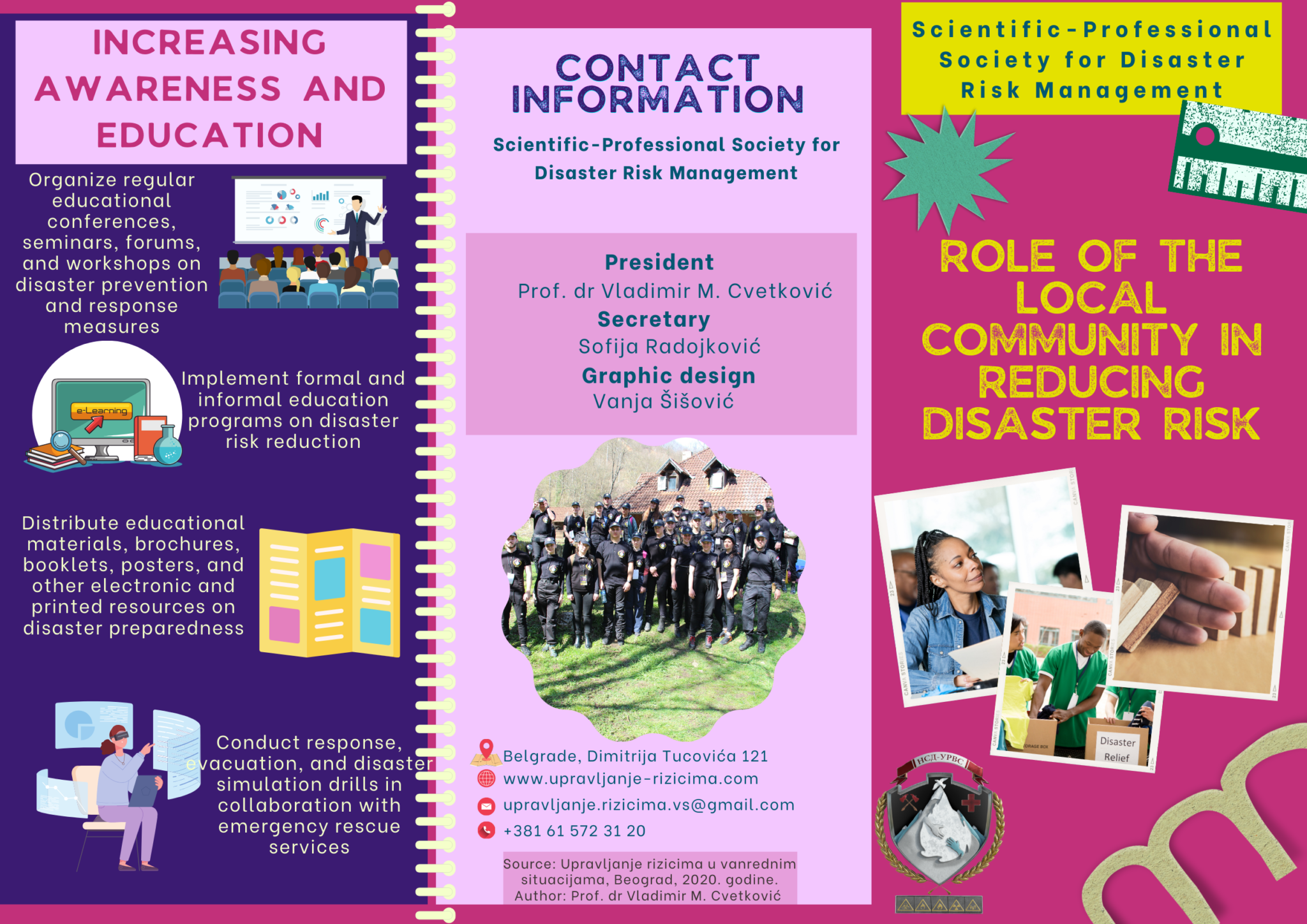
The Role of the Local Community in Disaster Risk Reduction
Educational Brochure - Guidelines for Action in Emergency Situations Caused by Hazardous Materials
Educational Brochure - Guidelines for Action in Emergency Situations Caused by Avalanches
Key Recommendations for Successful Communication in Emergency Situations
EDUCATIONAL BROCHURE - INSTRUCTIONS FOR ACTION IN EMERGENCIES CAUSED BY FOREST FIRES
Educational Brochure - Instructions for Action in Disaster Situations Caused by Droughts
Educational Brochure - Instructions for Action in Disaster Situations Caused by Extreme Temperatures
Educational Brochure - Instructions for Action in Disaster Situations Caused by Tsunamis
Educational Brochure - Instructions for Action in Disaster Situations Caused by Epidemics
Educational Brochure - Instructions for Action in Disaster Situations Caused by Volcanic Eruptions
The Role of Schools in Reducing Disaster Risk
Educational Brochure - Instructions for Action in Disaster Situations Caused by Storms
Educational Brochure - Instructions for Action in Disaster Situations Caused by Landslides
Educational Brochure - Instructions for Action in Disaster Situations Caused by Earthquakes
Educational Brochure - Instructions for Action in Disaster Situations Caused by Fires
Educational Brochure - Instructions for Action in Disaster Situations Caused by Floods
Brochure of the Scientific-Professional Society for Disaster Risk Management - President Prof. Dr. Vladimir M. Cvetković
Brochure of the International Journal of Disaster Risk Management (IJDRM)
Booklet of the International Journal of Disaster Risk Management (IJDRM)


Informational Posters
Poster for the Second National Seminar in the Field of Disaster Risk Management, December 2023
Invitation for the Fifth Basic Safety Training in the Field of Disaster Situations in Winter Conditions, 2024
CALL FOR PAPERS POSTER FOR THE PROCEEDINGS - Integrated Disaster Risk Management: Preparedness, Mitigation, Response, and Recovery
Poster of the Scientific-Professional Society for Disaster Risk Management