Comparative analysis of DRM systems in Germany, USA, Russia and China

Comparative analysis of DRM systems is the central topic of this scientific publication. Abstract The uniqueness of each system stems from the fact that the risks of disasters are specific and that their presence and manifestation are not universal and the same for every country. Just as no country is the same in […]

Read more
The Role of Social Media in the Process of Informing the Public About Disaster Risks (Uloga društvenih medija u procesu informisanja javnosti o rizicima od katastrofa)

The Role of Social Media is the central topic of this scientific publication. Abstract Social media informs the public about the most important events and conveys important information. Before, during, and after disasters, social media are used to disseminate information about disasters and collect data relevant to the implementation of preparedness, response, and […]

Read more

Disaster risk communication: Attitudes of Serbian citizens

Disaster risk communication Attitudes is the central topic of this scientific publication. Abstract The objective of this research was to examine the citizens’ attitudes to various factors influencing the implementation of effective disaster risk communication in the Republic of Serbia. In addition, the research aims to scientifically describe the predictors of successful disaster […]

Read more

In-Depth Analysis of Disaster (Risk) Management System in Serbia: A Critical Examination of Systemic Strengths and Weaknesses

In-Depth Analysis of Disaster Risk is the central topic of this scientific publication. Abstract This study comprehensively explores Serbia’s Disaster (Risk) Management System, aiming to critically evaluate its inherent strengths and weaknesses. Using descriptive-analytical methods and qualitative interpretation, SWOT analysis was applied to collect data from scientific papers, books, and institutional reports. This […]

Read more

Optimising Disaster Resilience Through Advanced Risk Management and Financial Analysis of Critical Infrastructure in the Serbian Defence Industry

Optimising Disaster Resilience Through Advanced is the central topic of this scientific publication. Abstract This paper presents a comprehensive analysis of the financial factors and risk management strategies essential for optimizing disaster resilience within the Serbian defence industry’s critical infrastructure. The significance of this sector is multi-faceted, impacting national security, economic stability, and […]

Read more

Challenges and Obstacles in the Use of Search and Rescue Dogs During Disaster Operations: A Case Study of the Earthquake in Turkey

Challenges and Obstacles is the central topic of this scientific publication. Abstract Deploying search and rescue (SAR) dogs in disaster situations is crucial for effective rescue missions. This study delves into the challenges and obstacles encountered during the use of SAR dogs, particularly focusing on the earthquake that hit Turkey in February 2023. […]

Read more

Tactical Approaches to Protection and Rescue in Traffic Accident-Induced Disasters

Tactical Approaches to Protection is the central topic of this scientific publication. Abstract This study delves into the complex challenges that arise when managing rescue operations in the aftermath of traffic accidents spanning various forms of transportation, including roads, railways, aviation, and waterways. Given the inherent complexity of traffic-related disasters, these events typically […]

Read more

Gender differences in stress intensity and coping strategies among students – Future emergency relief specialists

Gender differences in stress intensity is the central topic of this scientific publication. Abstract Introduction. Assisting students face high academic demands which, together with interpersonal, intrapersonal and professional requirements, can be a significant source of stress. The aim of the research was to examine the intensity and frequency of the source of stress, […]

Read more

Household earthquake preparedness in Serbia – a study from selected municipalities

Household earthquake preparedness in Serbia is the central topic of this scientific publication. Abstract This article presents the results of a qualitative study of household earthquake and community-level preparedness in Serbia and its relationship to various demographic factors. A series of 1,018 face-to-face interviews were conducted at the beginning of 2017 in eight […]

Read more

Capacity Development of Local Self-Governments for Disaster Risk Management

Capacity Development of Local Self-Governments is the central topic of this scientific publication. Abstract The objective of this research was to examine the capacity development of local self-governments in the field of disaster risk management (DRM). This quantitative research examines the degree of implementation of strategic, legislative, and institutional frameworks, as well as […]

Read more

Factors of Vulnerability and Resilience of Persons with Disabilities During Disasters: Challenges and Strategies for Inclusive Risk Reduction

Factors of Vulnerability and Resilience is the central topic of this scientific publication. Abstract Persons with disabilities (PWDs) are among the most at-risk groups during disaster situations due to various physical, sensory, cognitive, and systemic challenges that hinder their ability to prepare for, respond to, and recover from crises. Although international legal frameworks […]

Read more

Understanding the Sustainable Development of Community (Social) Disaster Resilience in Serbia: Demographic and Socio-Economic Impacts

Understanding the Sustainable Development is the central topic of this scientific publication. Abstract This paper presents the results of quantitative research examining the impacts of demographic and socioeconomic factors on the sustainable development of community disaster resilience. The survey was carried out utilizing a questionnaire distributed to, and subsequently collected online from, 321 […]

Read more

Sustainable Earthquake Preparedness: A Cross-Cultural Comparative Analysis in Montenegro, North Macedonia, and Serbia

Sustainable Earthquake Preparedness A Cross-Cultural is the central topic of this scientific publication. Abstract Authorities and governmental bodies strongly emphasize the importance of residents preparing for natural disasters, particularly underscoring the significance of readiness for geophysical hazards like earthquakes. In this study, which represents comparative quantitative research, the levels and predictors of the […]

Read more

Exploring Environmental Awareness, Knowledge, and Safety: A Comparative Study among Students in Montenegro and North Macedonia

Exploring Environmental Awareness Knowledge is the central topic of this scientific publication. Abstract This comparative study aims to investigate environmental awareness, knowledge, and safety among students in Montenegro and North Macedonia, considering the unique socio-cultural and environmental contexts of both countries. A mixed-methods approach involving surveys and interviews was employed to gather data […]

Read more

Assessing risk-prone areas in the Kratovska Reka catchment (North Macedonia) by integrating advanced geospatial analytics and flash flood potential index

Assessing risk-prone areas is the central topic of this scientific publication. Abstract This study presents a comprehensive analysis of flash flood susceptibility in the Kratovska Reka catchment area of Northeastern North Macedonia, integrating Geographic Information System, remote sensing, and field survey data. Key factors influencing flash flood dynamics, including Slope, Lithology, Land use, […]

Read more

Dealing with High-Risk Police Activities and Enhancing Safety and Resilience: Qualitative Insights into Austrian Police Operations from a Risk Perception and Group Dynamic Perspective

Dealing with High-Risk Police Activities is the central topic of this scientific publication. Abstract Special police units, such as Austria’s EKO Cobra, are uniquely trained to manage high-risk operations, including terrorism, amok situations, and hostage crises. This study delves into the operational risks and the critical role of group dynamics in fostering safety […]

Read more

Understanding seismic hazard resilience in Montenegro: A qualitative analysis of community preparedness and response capabilities

Understanding seismic hazard resilience is the central topic of this scientific publication. Abstract Enhancing resilience against seismic hazards in earthquake-prone regions is essential for reducing the devastating impacts of disasters. Seismic resilience refers to a community’s ability to withstand and recover from earthquake impacts, while preparedness gaps are the areas where current measures […]

Read more

Exploring Local Attitudes Towards Sustainable Tourism Development and Community Resilience in Skadar Lake and Durmitor National Parks, Montenegro: A Socio-Demographic Analysis

Exploring Local Attitudes Towards Sustainable is the central topic of this scientific publication. Abstract The study examines the attitudes of local residents toward the impacts of sustainable tourism development in two national parks in Montenegro—Skadar Lake National Park (NP) and Durmitor National Park (NP). The aim is to identify the key factors shaping […]

Read more

The Influence of Socio-Demographic Factors on Local Attitudes Towards Sustainable Tourism Development in Skadar Lake and Durmitor National Parks, Montenegro

The Influence of Socio-Demographic Factors is the central topic of this scientific publication. Abstract This study investigates the attitudes of local residents regarding the impacts of sustainable tourism development in two national parks in Montenegro: Skadar Lake National Park (NP) and Durmitor National Park (NP). The aim is to identify the key factors […]

Read more

A Cross-National Study of Disaster Risk Management: Strengths and Weaknesses in Bulgaria, Romania, and Albania with Reflections on Serbia

A Cross-National Study of Disaster is the central topic of this scientific publication. Abstract This study examines disaster risk management systems in Bulgaria, Romania, and Albania, highlighting their distinct strengths and weaknesses while drawing comparisons to Serbia’s framework. The research underscores the growing urgency of disaster risk management in addressing challenges posed by […]

Read more

Dealing with High-Risk Police Activities and Enhancing Safety and Resilience: Qualitative Insights into Austrian Police Operations from a Risk and Group Dynamic Perspective

Dealing with High-Risk Police Activities is the central topic of this scientific publication. Abstract Special police units like Austria’s EKO Cobra are uniquely trained to manage high-risk operations, including terrorism, amok situations, and hostage crises. This study ex-plores how group dynamics contribute to operational safety and resilience, emphasis-ing the interconnection between risk perception, […]

Read more

Spatio-temporal analysis of flood events using GIS and remote sensing-based approach in the Ukrina River Basin, Bosnia and Herzegovina

Spatio-temporal analysis of flood events is the central topic of this scientific publication. Abstract The subject of this research is the analysis of flood dynamics in the Ukrina River Basin, Bosnia and Herzegovina, using a remote sensing-based approach and geographic information systems during the period 2016–2019. The aim is to identify the spatial […]

Read more

A Predictive Framework for Understanding Multidimensional Security Perceptions Among Students in Serbia: The Role of Institutional, Socio-Economic, and Demographic Determinants of Sustainability

A Predictive Framework for Understanding is the central topic of this scientific publication. Abstract This study investigates and forecasts multidimensional security perceptions among Serbian university students, who are a particularly engaged and vulnerable demographic in transitional societies. It examines how demographic traits, socio-economic status, and levels of institutional trust and engagement shape students’ […]

Read more

Beyond the Original BRIC Model: Gaps, Limitations, and Adaptation of Community Resilience Indicators for Local Contexts

Beyond the Original BRIC Model is the central topic of this scientific publication. Abstract This paper reviews the development and adaptations of the BRIC (Baseline Resilience Indicators for Communities) method for measuring local community resilience to disasters, grounded in the DROP (Disaster Resilience of Place) theoretical framework. The point of departure is the […]

Read more

Assessing the Impact: Mortality from Infectious Disease in Trnava (1911 – 1941) through a Medical Geography Lens

Assessing the Impact Mortality from is the central topic of this scientific publication. Abstract This study examines mortality from infectious diseases in the Municipality of Trnava between 1911 and 1941. Conducted at the Historical Archive in Kraljevo (Serbia), the research employs historical-demographic, medical-geographic, and demographic-statistical methods. The Municipality of Trnava existed from 1839 […]

Read more

Digital Platform for Ecological Education of Students – Advancing the United Nations Sustainable Development Goals and the European Green Deal: The Case of ProSafeNet (Global Hub)

Digital Platform for Ecological Education is the central topic of this scientific publication. Abstract Achieving the United Nations Sustainable Development Goals (SDGs) and the European Green Deal (EGD) requires more efficient pathways that connect learning directly to real-world actions. This review introduces and explores a student-centered digital platform for ecological education that encourages […]

Read more

Regulating Emerging Technologies in Disaster Management: A Comparative Analysis of Security Governance and Legal Liability in India and Serbia

Regulating Emerging Technologies in Disaster is the central topic of this scientific publication. Abstract The integration of emerging technologies such as artificial intelligence (AI), drones, IoT sensors, big data, and blockchain is revolutionizing disaster management by enhancing response speed and effectiveness. However, these advancements introduce significant challenges in security governance and legal liability, […]

Read more

Community-Based Disaster Risk Reduction: Overcoming Barriers to Build Stronger Communities

Community-Based Disaster Risk Reduction Overcoming is the central topic of this scientific publication. Abstract Community-Based Disaster Risk Reduction (CBDRR) plays a vital role in strengthening local communities’ resilience against natural hazards and man-made disasters. This paper aims to examine the role of CBDRR in enhancing the resilience of local communities to both natural […]

Read more

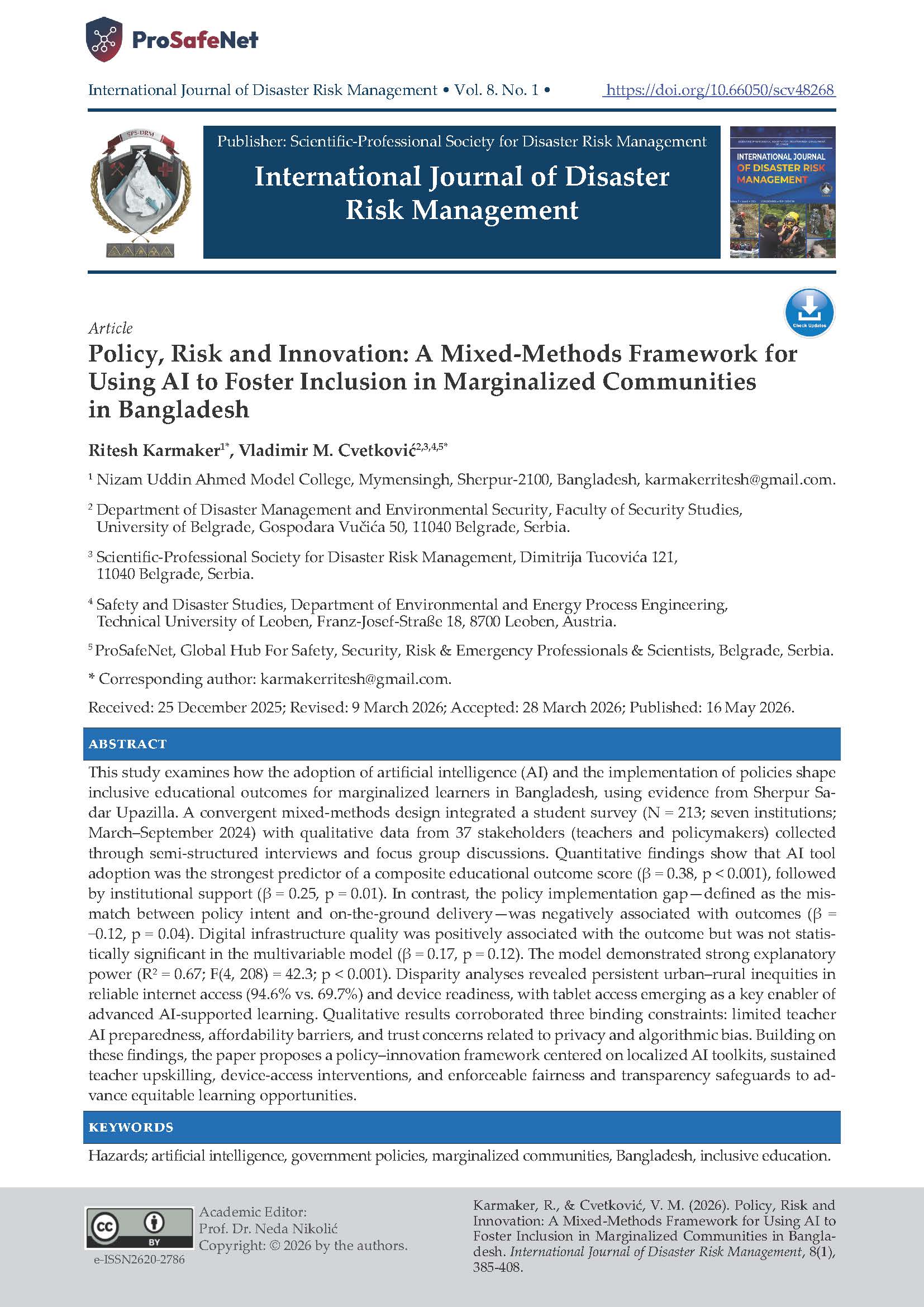
Policy, Risk and Innovation: A Mixed-Methods Framework for Using AI to Foster Inclusion in Marginalized Communities in Bangladesh

Policy Risk and Innovation A is the central topic of this scientific publication. Abstract This study examines how the adoption of artificial intelligence (AI) and the implementation of policies shape inclusive educational outcomes for marginalized learners in Bangladesh, using evidence from Sherpur Sadar Upazilla. A convergent mixed-methods design integrated a student survey (N […]

Read more

Artificial Intelligence in Predicting Emissions and Environmental Incidents in IPPC Installations: The Bor Mine as a Case Study

Artificial Intelligence in Predicting Emissions is the central topic of this scientific publication. Abstract The Bor mining complex represents one of the most significant industrial installations in Serbia, characterized by a long history of intensive metallurgical and mining activities and a substantial impact on local air quality and environmental safety. As an IPPC […]

Read more

Assessing Disaster Risk and Adaptation Strategies in Coastal Agriculture: Evidence from Chandradip Union of Bauphal Upazila, Bangladesh

Assessing Disaster Risk and Adaptation is the central topic of this scientific publication. Abstract The coastal zone of Bangladesh is highly vulnerable to natural disasters, which significantly affect agricultural production and livelihoods. Agriculture is the primary livelihood for most coastal communities. Patuakhali is a coastal district of Bangladesh, and Bauphal Upazila is one […]

Read more

Theoretical evolution of measuring community resilience to natural and technological disasters: past, present, and future – empirical insights from qualitative research in Serbia

Theoretical evolution of measuring community is the central topic of this scientific publication. Abstract In disaster studies, the measurement of resilience has developed through several conceptual phases, reflecting broader transformations in disaster risk research. It is clear that the initial approaches, rooted in ecology and engineering, defined resilience primarily as a system’s ability […]

Read more
Honoured to Be Elected Full Professor of Disaster Risk Management, Vladimir M. Cvetković

Honoured to Be Elected Full Professor of Disaster Risk Management

Honoured to Be Elected Full is the central topic of this scientific publication. It is with great pride and sincere gratitude that I share a milestone which represents one of the most significant moments of my academic career: I have been elected Full Professor of Disaster Risk Management at the Faculty of Security […]

Read more
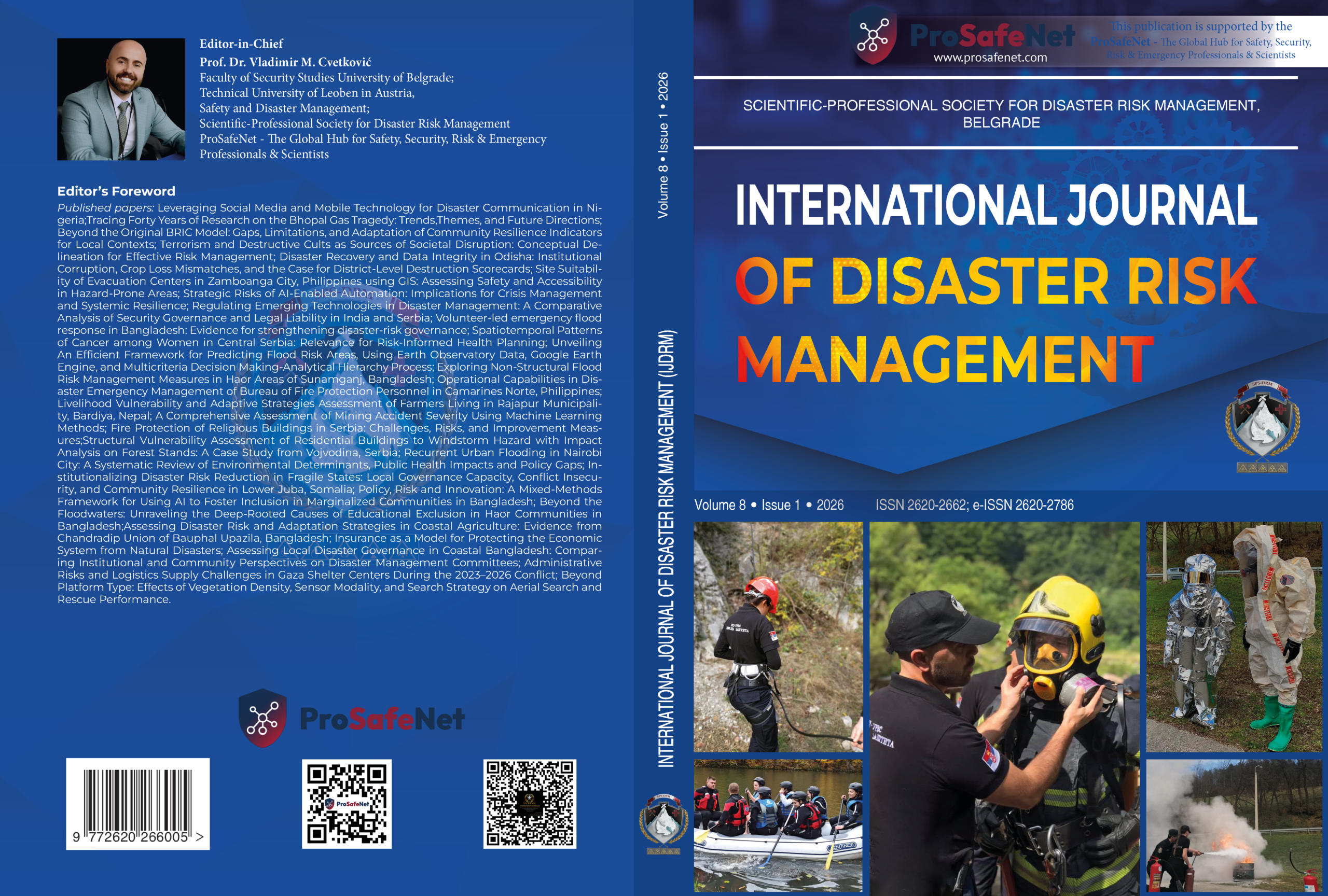
International Journal of Disaster Risk Management

International Journal of Disaster Risk Management — Vol. 8, No. 1, 2026

International Journal of Disaster Risk is the central topic of this scientific publication. I am pleased to announce, as Editor-in-Chief, the publication of the new issue of the International Journal of Disaster Risk Management — Vol. 8, No. 1, 2026, published by the Scientific-Professional Society for Disaster Risk Management, Belgrade, with the support […]

Read more
Policy, Risk and Innovation: A Mixed-Methods Framework for Using AI to Foster Inclusion

Policy, Risk and Innovation: A Mixed-Methods Framework for Using AI to Foster Inclusion in Marginalized Communities in Bangladesh

Policy Risk and Innovation A is the central topic of this scientific publication. This study examines how the adoption of artificial intelligence (AI) and the implementation of policies shape inclusive educational outcomes for marginalized learners in Bangladesh, using evidence from Sherpur Sadar Upazilla. A convergent mixed-methods design integrated a student survey (N = […]

Read more
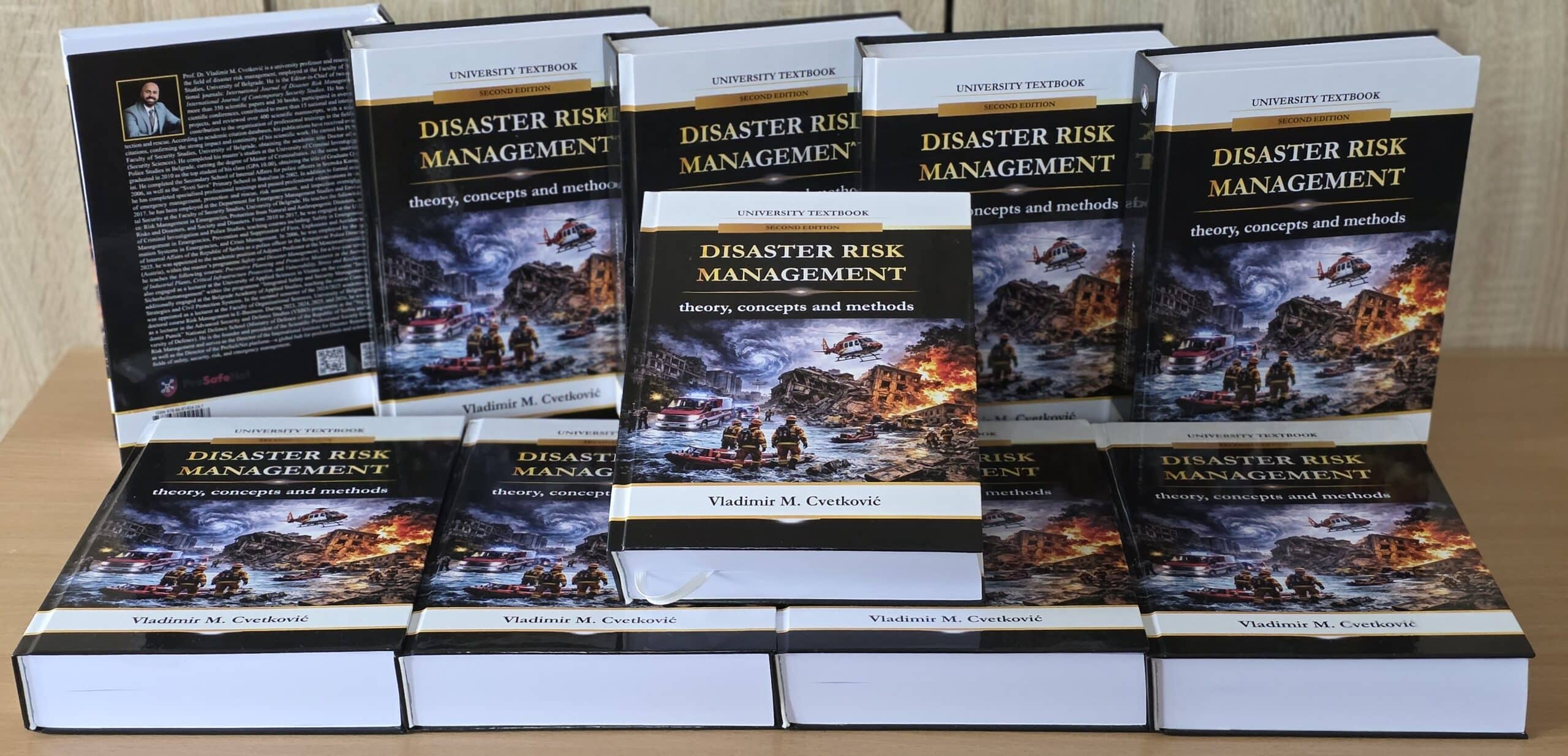
Concepts and Methods”, authored by Prof. Dr. Vladimir M. Cvetković, is now

Order the New Revised and Expanded Edition of “Disaster Risk Management”

The new revised and expanded edition of the university textbook “Disaster Risk Management: Theory, Concepts and Methods”, authored by Prof. Dr. Vladimir M. Cvetković, is now available for ordering. This textbook provides a comprehensive and contemporary overview of the theoretical foundations, key concepts and methods of disaster risk management, with a focus on […]

Read more
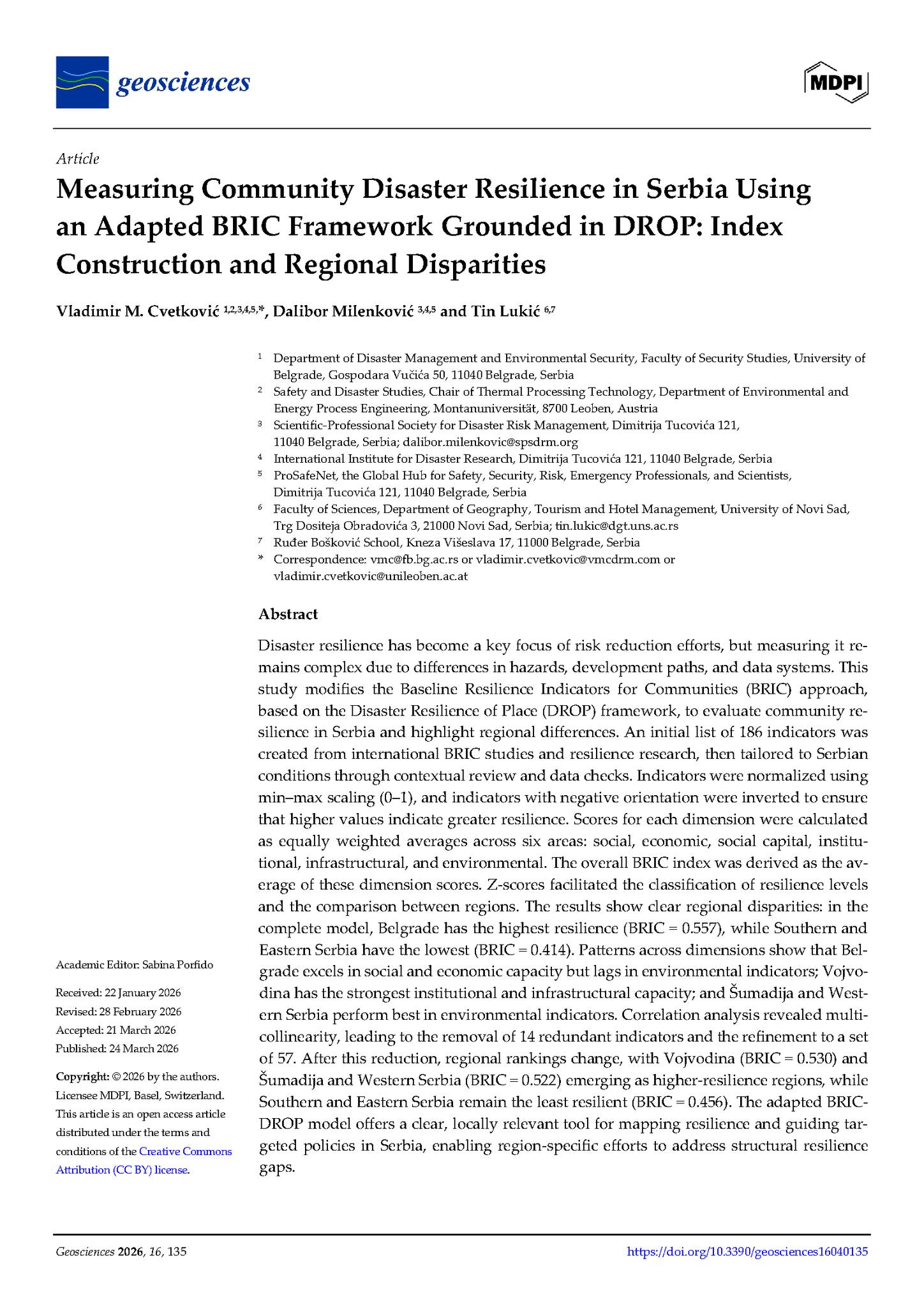
Using an Adapted BRIC Framework

Predictive Model of Community Disaster Resilience Across Serbia: A BRIC–DROP Composite Index and Spatial Patterns

Predictive Model of Community Disaster is the central topic of this scientific publication. Community disaster resilience is increasingly guiding risk-reduction investments, but in many Southeast European settings, comparable subnational data remain scarce. This study assesses perceived community disaster resilience across Serbia by combining BRIC–DROP dimensions into a single index and analyzing differences across […]

Read more