I am delighted to share our latest research article published in Open Geosciences (De Gruyter).
My special congratulations and sincere appreciation go to Tin Lukić, an outstanding researcher and valued colleague, for his scientific dedication, expertise, and valuable contribution to this collaborative work. It is always a great pleasure to collaborate with him and our excellent interdisciplinary research team. This publication reflects the strength of interdisciplinary teamwork and our shared commitment to advancing disaster risk reduction research.
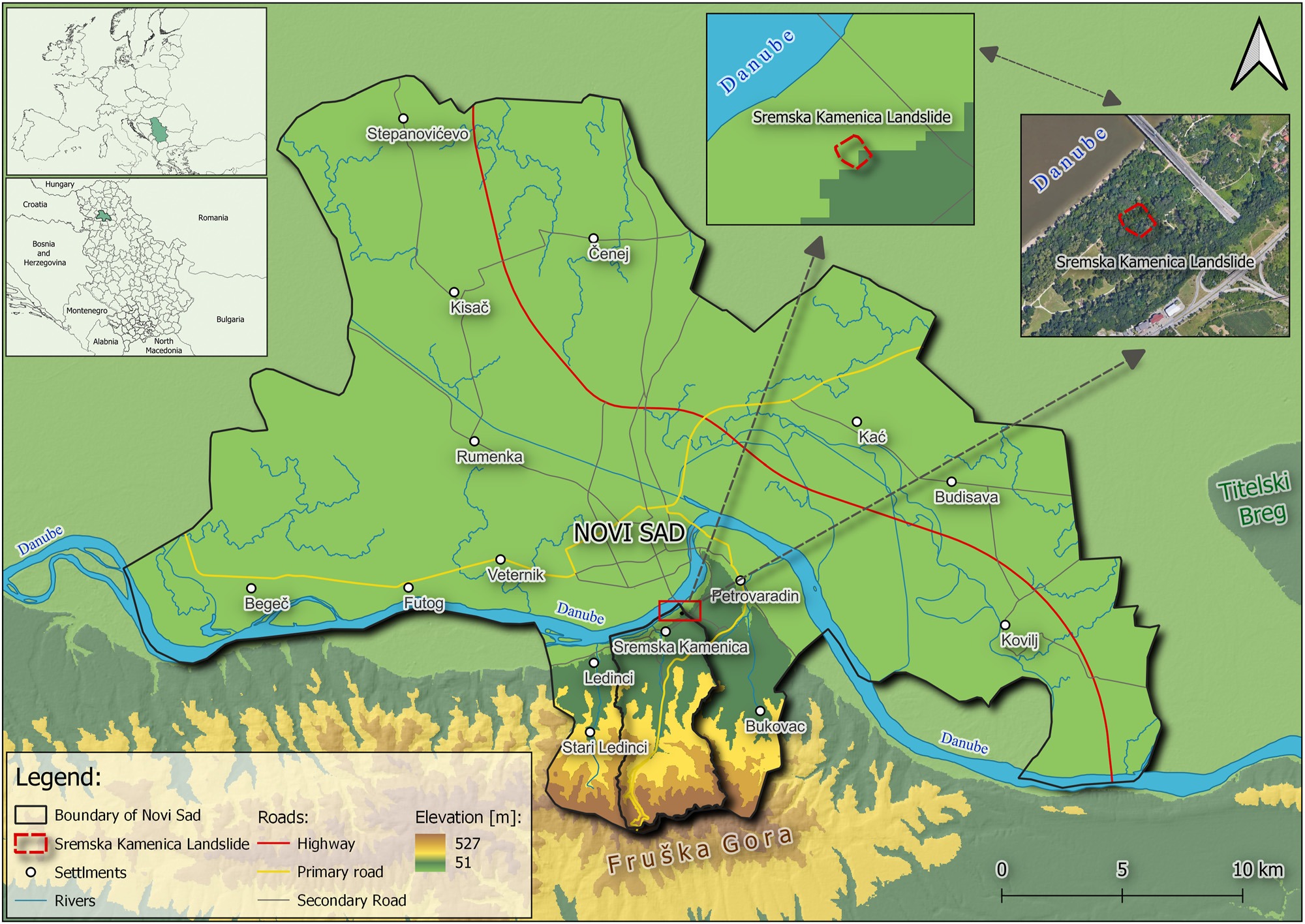
“Integrated Assessment of Landslide Activity on the Danube Slope: Sremska Kamenica, Serbia”
Our research investigates how changing precipitation patterns, geological conditions, and urban expansion interact to influence landslide activity along the Danube River.
KEY FINDINGS
• Analysis of 64 years of climate data (1961–2024) reveals a statistically significant increase in annual precipitation of approximately 2.08 mm per year.
• Changes in rainfall distribution, particularly significant increases during spring and autumn, highlight evolving hydroclimatic pressures on slope stability.
• Urban expansion and land-use transformations may influence drainage conditions and slope instability, with built-up areas increasing by 0.80 km² between 2017 and 2024.
• The proximity of critical infrastructure, including the Sloboda Bridge, underscores the importance of integrated disaster risk management, continuous monitoring, and risk-informed spatial planning.
Disaster risk is shaped not by natural hazards alone, but by the complex interaction of environmental processes, human activities, and infrastructure vulnerabilities.
Understanding these interactions is essential for strengthening community resilience, protecting critical infrastructure, and advancing evidence-based disaster risk management.
How can we better translate scientific evidence into effective land-use planning and proactive disaster risk management?
Read the full open-access article: https://doi.org/10.1515/geo-2025-1024
As climate variability, urbanization, and infrastructure interdependencies increasingly shape disaster risk, we need to move beyond studying individual hazards toward understanding their interactions, potential cascading consequences, and wider implications for community and systemic resilience.
The future of disaster risk management lies not only in responding to disasters, but in transforming how we anticipate, govern, and reduce risk before disasters occur.