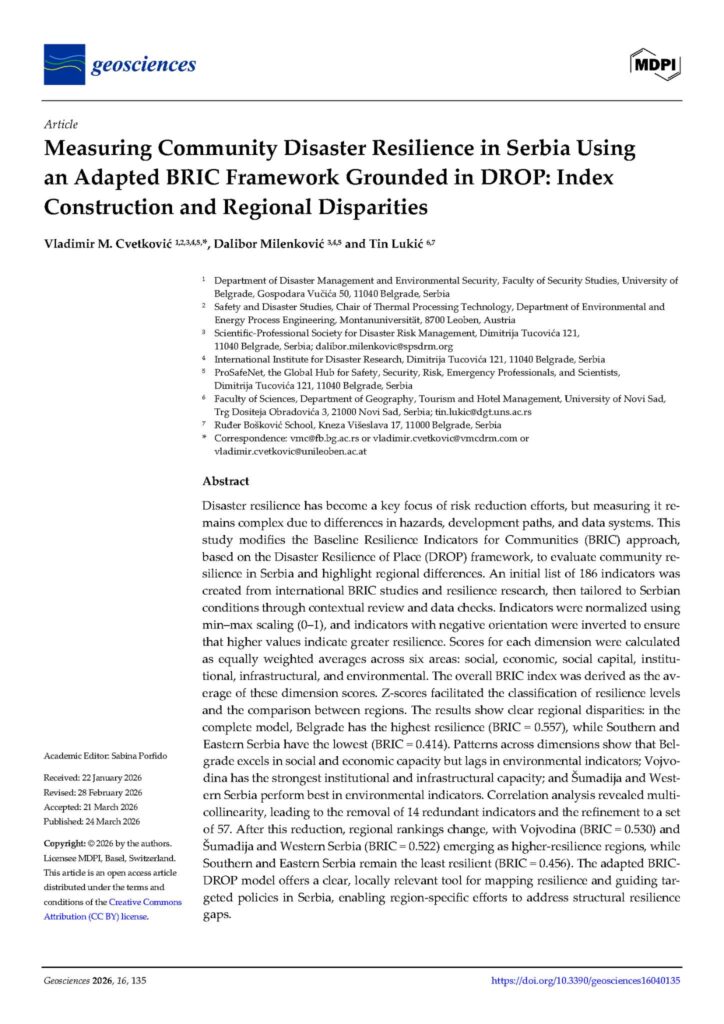
Our new scientific paper has been published in the international, peer-reviewed journal Geosciences (MDPI), which, according to the journal’s official data, has an Impact Factor of 2.1 (2024) and a 5-Year Impact Factor of 2.5 (2024). The paper, entitled “Measuring Community Disaster Resilience in Serbia Using an Adapted BRIC Framework Grounded in DROP: Index Construction and Regional Disparities,” was published as part of the special issue Innovative Solutions in Disaster Research, which gives this study additional visibility within contemporary interdisciplinary research on disasters and resilience.
This study developed a methodologically adapted indicator for measuring community disaster resilience in Serbia and its regions, based on an adaptation of the well-known BRIC approach and the DROP theoretical framework. The aim was to tailor an internationally recognized methodological model to the specific characteristics of the national social, institutional, developmental, and statistical context, in order to obtain a reliable instrument for measuring, comparing, and spatially mapping resilience.
From a methodological perspective, the research began with the construction of an initial database of 186 indicators, drawn from and synthesized on the basis of international BRIC studies and the broader disaster resilience literature. The indicators were then carefully reviewed and adjusted to the Serbian context through contextual analysis and an assessment of data availability and quality. The indicator values were subsequently standardized using min–max normalization on a scale from 0 to 1, while negatively oriented indicators were inverted so that higher values would consistently indicate a higher level of resilience.
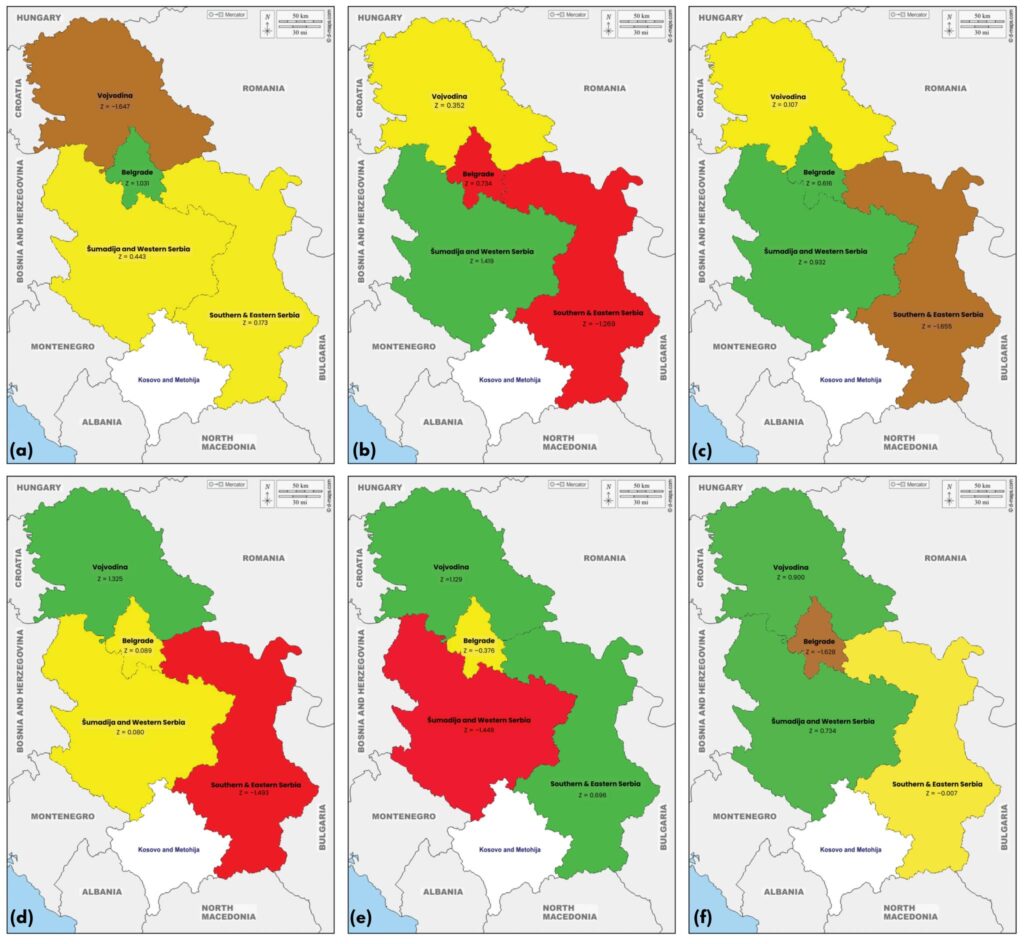
Furthermore, resilience across the regions of Serbia was measured through six key dimensions: social, economic, social capital, institutional, infrastructural, and environmental. The results for each dimension were calculated as equally weighted averages of the corresponding indicators, while the overall BRIC index was computed as the average of all dimensional scores. In addition, the application of z-scores enabled the classification of resilience levels and a clearer comparison among regions.
The results revealed pronounced regional disparities. In the full model, Belgrade recorded the highest level of resilience (BRIC = 0.557), while Southern and Eastern Serbia had the lowest level (BRIC = 0.414). When examined by dimension, Belgrade stands out in terms of social and economic capacities, but lags behind in environmental indicators; Vojvodina demonstrates the strongest institutional and infrastructural capacities; while Šumadija and Western Serbia achieve the best results in the area of environmental resilience.
It is particularly important that the correlation analysis indicated the presence of multicollinearity, which led to the removal of 14 redundant indicators and the reduction of the model to 57 methodologically more stable variables. After this reduction, the regional ranking also changed, with Vojvodina (BRIC = 0.530) and Šumadija and Western Serbia (BRIC = 0.522) emerging as the regions with higher levels of resilience, while Southern and Eastern Serbia remained the region with the lowest measured level of resilience (BRIC = 0.456).
This paper is significant because it offers not only a theoretical contribution, but also a concrete empirical instrument for measuring, analyzing, and cartographically presenting regional differences in disaster resilience in Serbia. The developed model may serve as an important basis for public policymaking, the targeting of preventive measures, and more precise intervention planning in regions where the structural capacities for resilience are the least developed.
https://www.mdpi.com/2076-3263/16/4/135